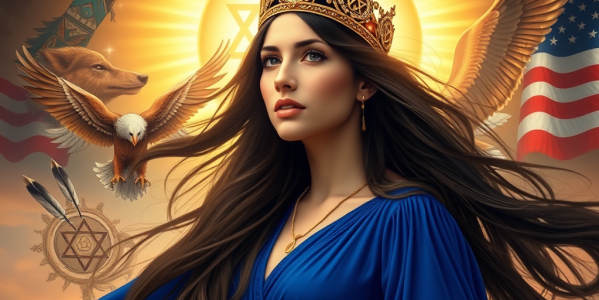
Trinity Cults: Oriental and Zoroastrian

Welcome back to

Marie Speaks G-d’s Grace Bible Study.

This is Season 7 of Marie Speaks G-d’s Grace.

I hope everyone has been enjoying reviewing of Trinity Cults. We have reviewed the main Trinity Cults of Meso-America. These include the Aztecs, Mayans, and Incas. We also reviewed the Greek aka Helenes and Roman, Egyptian, Assyria, and Babylonia Trinity Cults. Now, we will take a look at Oriental and Zoroastrian, for our final BLOG of Season 7.

WOW!!!! 7 Seasons!!!!

B’H

Video 1: Trinity Cults: Oriental and Zoroastrian

Video 2: Trinity Cults: Oriental and Zoroastrian ( Intermarriage and itis)

Video 3: Final Video of Season 7 Trinity Cults: Oriental and Zoroastrian

We kicked off Part 2 of Season 7 by identifying the addiction of idolatry and paganism. Additionally, we reviewed measures that are used in institutions such as schools, work, and social. Measures that were under the cloak of “education” or “enlightenment” or, what is deemed socially acceptable. Essentially, the methods implemented had the main objective of breaking the will of those who wanted a true relationship with The One True Living God.

Previously, we reviewed in Bereshit Genesis ch 22: 1= Singularity, 2= Distinction, and together they make 3= Harmony; the physical reality of the spiritual ascension events that actually took place during the “offering” of Issac may peace be upon him, by The Father of our Faith Abraham.

In this closing BLOG and series of videos for 2nd Part of Season 7, we are focusing on other cases of stolen valor. Specifically, how the Trinity Cults, have attempted to lech onto the monotheism of Torah Observant ( commonly known as Orthodox) Judaism.

*This BLOG contains AI generated information through out.*

After reviewing the Trinity Cults of Aztecs, Mayan, and Inca, Greek aka Hellenes and Roman, Egyptian, Assyria, and Babylonia Trinity Cults; I have a couple of questions:

Why are the state religions seemingly just repackaged Trinity Cult observances?

Why was it necessary for each state to force the observances of these Trinity Cults through laws and enforcers, if these cults were so loved by the people?

Why do the Trinity Cults vary in name only from territory to territory, but ultimately serve the same Enoch ch 6 fallen ones?

Was one of the reasons the re-imagined and repackaged cults able to multiply generation to generation due to some sort of reset? If there was a reset of sorts, how was the reset applied in each generation?

Generational Reset Theory

The concept of generational theory examines how different generations, shaped by their unique historical contexts, influence and react to each other. William Strauss and Neil Howe proposed a cyclical model in their book “The Fourth Turning,” suggesting that history repeats itself in cycles of approximately 85 years, or a “saeculum,” which is divided into four phases or “turnings.” Each phase is characterized by distinct generational archetypes and societal moods, such as the Awakening, the Unraveling, the High, and the Crisis.

How many resets could of possibly happen?

The Mud Flood Theory is a controversial conspiracy theory suggesting a catastrophic event in the mid-18th or 19th century that buried entire civilizations under layers of mud and debris. Proponents of this theory argue that buildings constructed before roughly 1850 were much taller and contained advanced technology, which they claim cannot be explained by conventional history books. However, architectural historians point out that such claims are implausible based on all known evidence, and there is no scientific evidence to support these ideas.

Regarding water and fire floods, some theorists suggest that a comet impact could have caused sudden changes in weather patterns, leading to devastating incidents like tsunamis and mudslides. This idea is similar to hypotheses that have been proposed to explain the Biblical Flood, where a comet encounter was suggested as the probable cause.

Wind is not directly mentioned in the Mud Flood Theory, but it is relevant in the context of how structures would fare over time. For instance, tall buildings without modern reinforcements would likely collapse due to wind forces long before now, making the theory’s claims about ancient structures implausible.

Which son of Noah do the Oriental and Zoroastrian descend?

Descendants of Noah’s Sons

The descendants of Japheth are associated with the geographic area comprising the Aegean Sea, Greece, the Caucasus, and Anatolia, which includes some Oriental peoples. However, the origins of Oriental peoples are more commonly traced to the descendants of Shem and Ham in biblical genealogies. Zoroastrianism, on the other hand, is traditionally associated with the descendants of Shem, as it is believed to have originated in the region where the Semitic peoples settled. The Chinese race, for example, is sometimes linked to the descendants of Canaan through the Sinites.

We know from our lesson: Part 2 Bereshit Genesis 20 & 21: 2 Kings, 1Queen, and 1 Princess Slave girl… What could go wrong!?! Hagar was giving by her father to Abraham and Sarah, as a slave girl. Abraham and Sarah, “concieved a child Ismael through Hagar. What we did not cover it that later after Sarah’s death the Abraham remarried Hagar under the name Keturah.

Abraham’s Descendants

Keturah was a wife and concubine of the Biblical patriarch Abraham. According to the Book of Genesis, Abraham married Keturah after the death of his first wife, Sarah. Abraham and Keturah had six sons: Zimran, Jokshan, Medan, Midian, Ishbak, and Shuah.

The descendants of Keturah’s sons include thirty families, expressing the fulfillment of the blessing given by God to Abraham in Genesis 12:3.2 For instance, Midian’s sons were Ephah, Epher, Hanoch, Abida, and Eldaah. Jokshan was the father of Sheba and Dedan, and Dedan’s descendants were the Asshurites, Letushites, and Leummites.

Some of Keturah’s descendants intermarried with the descendants of Isaac, Joktan, Midian, and Ishmael. However, the children of Keturah were not considered part of the Jewish nation, as they were not bound by the commandments of the Torah, which was given solely to Isaac’s progeny.

These offspring are also know as Semites. Meaning from the Line of Shem, a son of Noah.

Noah and the Torah

Noah did not follow the Torah in the way that later generations of Jews did, as the Torah was not yet given during his time. The Torah describes Noah as a righteous man who “walked with G‑d” and was in harmony with his Creator, but it does not indicate that he followed the specific commandments and laws later outlined in the Torah.

Noah lived before the time of Moses, who is traditionally credited with receiving the Torah from God on Mount Sinai. The Torah itself, which includes the story of Noah, was written much later and reflects a retrospective view of Noah’s righteousness and his relationship with God.

In the context of the flood story, Noah is depicted as following God’s instructions to build the ark and save his family and the animals, but these instructions are not part of the formal commandments found in the Torah.

Offered to Other Nations

According to midrashic accounts, God first offered the Torah to other nations before offering it to the Jewish people. The Midrash suggests that God offered the Torah to the descendants of Esau, Ammon, and Moav, but they all declined due to prohibitions within the Torah that contradicted their values or practices. This narrative is intended to demonstrate that the Jewish people were chosen not because of any inherent superiority but because they accepted the Torah when it was offered to them.

Rabbi Alan Haber explains that the Torah was designed to transform all human civilization and that the Jewish people were meant to serve as priests or ambassadors of the Torah to the rest of the world. This perspective supports the idea that the Torah’s principles are universal and intended for all people, not just the Jewish people.

Therefore, while the Torah was ultimately given to the Jewish people, the concept of its universal applicability suggests that God’s initial intention was for it to be accepted by all nations.

Noahide Laws Overview

The Noahide Laws, also known as the Seven Laws of Noah or Noachian Laws, are a set of universal moral laws that, according to Jewish tradition, were given by God to Noah and all of humanity. These laws are derived from the Talmud’s interpretation of Genesis 2:16 and Genesis 9:4-6.13

The seven laws are:

  1. Do not deny God (no idolatry).
  2. Do not blaspheme God.
  3. Do not murder.
  4. Do not engage in sexual immorality.
  5. Do not steal.
  6. Do not eat flesh torn from a living animal.
  7. Establish courts of justice.

Non-Jews are not required to convert to Judaism but are expected to observe these laws to ensure a place in the World to Come (Olam Ha-Ba), the final reward of the righteous.

These laws are not explicitly listed in the Bible but are derived from the Talmud, which is a collection of Jewish teachings, laws, and interpretations based on the Torah.

I however don’t subscribe to this Noahide theory. I believe all humanity is required to follow the 10 Commandments with follow on instructions from elders or righteous leaders of those nations of how to properly apply the 10 Commandments with each Nation.

For those that are interested in the Noahide life may I suggest:

Rabbi Chaim Coffman

Rabbi Chaim Coffman is a Torah teacher and spiritual coach who works with people on the path to conversion to Judaism and those who want to live a biblical life. He is based in Beitar Illit, Israel, and has been learning Torah intensively for over 20 years. Rabbi Coffman’s mentor and Rabbi is Rav Moshe Sternbuch, one of the greatest Halachic Decisors in our generation, who fully endorses his mentorship program.

Rabbi Coffman provides guidance and training for Orthodox Conversion recognized by Beit Din worldwide. He has helped many individuals from diverse backgrounds prepare for Orthodox Conversion to Judaism, known for his vast knowledge, warm personal attention, and sense of humor.

He also hosts a podcast series called “Controversial Issues,” which addresses modern-day societal issues from a Jewish perspective. Additionally, Rabbi Coffman has a YouTube channel titled “Beyond Orthodox Conversion to Judaism”.

Rabbi Coffman’s approach emphasizes spiritual truth and Torah learning, aiming to help individuals integrate into the Orthodox Jewish community successfully.

Link: Noahide Nations Rabbinic Advisory Board – Rabbi Chaim Coffman

Facebook group: Noahide Nations – For All Mankind

As I have stated numerous times… I believe in the 10 Commandments for all nations with various oral or written laws applications each each nation. So lets review.

The Ten Commandments According to Torah

The Ten Commandments, also known as the Decalogue, are listed in the Torah, specifically in the books of Exodus and Deuteronomy. According to the Torah, the first commandment is “I am the Lord your God, who brought you out of the land of Egypt, out of the house of slavery” (Exodus 20:2, Deuteronomy 5:6). The second commandment is “You shall have no other gods before Me” (Exodus 20:3, Deuteronomy 5:7). The third commandment is “You shall not take the name of the Lord your God in vain” (Exodus 20:7, Deuteronomy 5:11). The fourth commandment is “Remember the Sabbath day, to keep it holy” (Exodus 20:8, Deuteronomy 5:12). The fifth commandment is “Honor your father and your mother” (Exodus 20:12, Deuteronomy 5:16). The sixth commandment is “You shall not murder” (Exodus 20:13, Deuteronomy 5:17). The seventh commandment is “You shall not commit adultery” (Exodus 20:14, Deuteronomy 5:18). The eighth commandment is “You shall not steal” (Exodus 20:15, Deuteronomy 5:19). The ninth commandment is “You shall not bear false witness against your neighbor” (Exodus 20:16, Deuteronomy 5:20). The tenth commandment is “You shall not covet your neighbor’s house, or his wife, or his male servant, or his female servant, or his ox, or his donkey, or anything that belongs to your neighbor” (Exodus 20:17, Deuteronomy 5:21). 

I believe there is significant archaeological evidence. It shows that the 10 Commandments have existed throughout each generation from ancient times to the present. This evidence is and has been archived and made available for the masses. I suggest others research these facts and determine for themselves from there.

*This BLOG contains AI generated information through out.*

Locations of the 10 Commandments

The Ten Commandments are prominently displayed in various locations around the world, often in stone or wood. One notable example is Fields of the Wood in Murphy, North Carolina, which features the world’s largest display of the Ten Commandments on the side of a mountain.

Ten Commandments Displayed Worldwide

The Ten Commandments have been displayed in various locations around the world over thousands of years. One of the earliest known copies was found among the Dead Sea Scrolls, which are considered one of the great archaeological finds of the 20th century. This ancient copy was written on goatskin and is one of humanity’s most precious documents, though it is so fragile that it is rarely moved from its secure vault where it rests in complete darkness.

In the 1950s and 1960s, the Fraternal Order of Eagles placed thousands of Ten Commandments displays in courthouses and school rooms, including many stone monuments on courthouse property. Additionally, director Cecil B. DeMille placed hundreds of monuments as a publicity stunt to promote his 1956 film “The Ten Commandments”.

Today, the Ten Commandments are displayed in synagogues during specific readings and festivals. They are also a subject of legal and political debate in the United States, with some states mandating their display in public schools.

With all the being said this get back on track with …..

Abraham Descendants Chart

Abraham’s descendants are detailed in various genealogical charts and texts. The family tree of Abraham includes his sons Isaac and Ishmael, who are the patriarchs of the Israelites and Arabs, respectively. Isaac’s descendants include Jacob, who is the father of the twelve tribes of Israel. Ishmael’s descendants are listed in Genesis 25:12-16 and include twelve princes named Nebaioth, Kedar, Adbeel, Mibsam, Mishma, Dumah, Massa, Hadad, Tema, Jetur, Naphish, and Kedemah.

Additionally, after Sarah’s death, Abraham married Keturah, who bore him six more sons: Zimran, Jokshan, Medan, Midian, Ishbak, and Shuah.

Here is a summary of Abraham’s descendants:

  • Isaac: Son of Abraham and Sarah, patriarch of the Israelites.
  • Ishmael: Son of Abraham and Hagar, patriarch of the Arabs.
  • Zimran: Son of Abraham and Keturah.
  • Jokshan: Son of Abraham and Keturah.
  • Medan: Son of Abraham and Keturah.
  • Midian: Son of Abraham and Keturah.
  • Ishbak: Son of Abraham and Keturah.
  • Shuah: Son of Abraham and Keturah.
  • Nebaioth: Son of Ishmael.
  • Kedar: Son of Ishmael.
  • Adbeel: Son of Ishmael.
  • Mibsam: Son of Ishmael.
  • Mishma: Son of Ishmael.
  • Dumah: Son of Ishmael.
  • Massa: Son of Ishmael.
  • Hadad: Son of Ishmael.
  • Tema: Son of Ishmael.
  • Jetur: Son of Ishmael.
  • Naphish: Son of Ishmael.
  • Kedemah: Son of Ishmael.

Semites Descendants Chart

The descendants of Shem, one of Noah’s sons, are listed in Genesis 10 and include Elam, Asshur (Assyria), Arphaxad, Lud, and Aram. From Arphaxad, the line continues through Shelah and Eber, with Eber’s sons Peleg and Joktan leading to further descendants. Joktan’s descendants are listed as Almodad, Sheleph, Hazarmaveth, Jerah, Hadoram, Uzal, Diklah, Obal, Abimael, Sheba, Ophir, Havilah, and Jobab.

The chart of descendants includes several notable groups:

  • Elam: A mountainous country on the east of Babylonia, known before 4000 BC.
  • Assyria: Descendants of Asshur, known for their historical empire.
  • Chaldea: Descendants of Arphaxad, known for their civilization in Mesopotamia.
  • Lydia: Descendants of Lud, known for their kingdom in Asia Minor.
  • Syria: Descendants of Aram, known for their historical and cultural contributions.

These descendants spread geographically from Lydia to Syria, Assyria, and Persia, with Armenia establishing the northern boundary and the Red Sea and the Persian Gulf creating the southern boundary.

Modern Semitic-speaking peoples include Arabs, Jews, and others who speak languages such as Hebrew, Arabic, Neo-Aramaic, Amharic, and Maltese.

Semitic vs Sinites

The term “Semites” refers to a group of peoples who speak or spoke Semitic languages, including Jews, Arabs, Assyrians, and others. The term “Sinites” is less common and generally refers to people of Chinese or East Asian descent, though it is not widely used in academic or linguistic contexts.

Who are the Sinites

The Sinites are a lesser-known group of people mentioned in the Bible, identified as descendants of Canaan, the son of Ham. They are listed among the descendants of Canaan in Genesis 10:17 and 1 Chronicles 1:15. The Sinites are one of several Canaanite tribes that inhabited the land of Canaan before the Israelites took possession of it. Some sources suggest that the Sinites may have given their name to China, and later migrated into Australia, forming part of the Murrayian Aboriginal people.

The name “Sinites” is derived from the Hebrew word סינים (Sīnīm), which could mean “thorn” or “clay”. The exact location of the Sinites is uncertain, but they are often associated with the northern part of Lebanon, where there are localities with similar names such as Sinna, Sinum, or Sini.

In the biblical narrative, the Sinites, like other Canaanite tribes, faced judgment due to their idolatry and disobedience to God, reflecting God’s holiness and justice. The Sinites’ story highlights the consequences of idolatry, the reality of spiritual warfare, and the importance of obedience to God.

According to biblical interpretations, the Chinese and Japanese are believed to be descendants of Noah’s sons, specifically Ham and Japheth. Some sources suggest that the Chinese are descendants of Ham, particularly through his grandson Canaan, and are referred to as Sinites . Others argue that the Chinese could also be descendants of Japheth, as Islamic tradition identifies the descendants of Japheth as including the Chinese, Mongols, and Slavs. There is no consensus on a single ancestor among Noah’s sons for the Chinese and Japanese, and different traditions offer varying perspectives.

Are Chinese and Japanese Genetically Similar?

No, Chinese and Japanese people are not genetically the same. According to a study published in the journal Hereditas (Beijing), researchers found genetic differences between northern Chinese, Korean, and Japanese populations, with more than 99% accuracy in identifying someone’s origin based on genetic markers.

A 2018 study calculated pairwise FST (a measure of genetic difference) among Han Chinese, Japanese, and Korean populations, and found that the smallest FST value was between Northern Han Chinese and Southern Han Chinese (FST[CHB-CHS] = 0.0014), while the FST between Northern Han Chinese and Korean (FST[CHB-KOR] = 0.0026) and between Korean and Japanese (FST[JPT-KOR] = 0.0033) were larger. This suggests that Han Chinese, Japanese, and Korean populations are genetically distinct.

Furthermore, a study published in Science Advances in 2024 found that the Japanese population can be optimally divided into three clusters, with different concentrations in Okinawa, Northeastern Japan, and Western Japan. This study also confirmed that there is a Northeast Asian ancestry in the Japanese population, likely composed of people from the Korean peninsula or early non-Jomon Japanese populations.

These studies indicate that while there are genetic similarities among East Asian populations, there are also distinct genetic differences between Chinese and Japanese people.

We review these bloodlines in the Bereshit Genesis 10, 11, 12 Ancestry and Bloodlines, Oh My! class for those who would love a review. What I have found Aztec, Mayans, Hellenes (Greeks), Roman, Babylonians and Assyrians, Oriental and Zoroastrian; are basically the same people groups. I know sounds wild, but stay with me. Aztec, Mayans, Hellenes (Greeks), Roman, Babylonians and Assyrians, Oriental and Zoroastrian, are the same people group or nations, but with different staring dates. Apparently, after a war or reset, each people group were given new names by there conquers. Then their conquers forced the people to follow new laws and new gods.

Yes, I still have more and more questions.

What gods the Aztec, Mayans, Hellenes (Greeks), Roman, Babylonians and Assyrians, Oriental and Zoroastrian have in common?

Common Gods and Goddesses List

  • Chac: The supreme god of storms and rain in Mayan mythology, similar to the Roman god Jupiter, Greek Zeus, and Babylonian Marduk, who were all associated with storms and rain.
  • Tlaloc: The Aztec god of rain and fertility, comparable to the Greek god Poseidon, Roman Neptune, and Babylonian Ea, who were all associated with water and fertility.
  • Quetzalcoatl: The Aztec god of wind, learning, and crafts, similar to the Greek god Hermes, Roman Mercury, and Babylonian Nabu, who were all associated with wisdom and communication.
  • Kinich Ahau: The Mayan god of the sun and war, analogous to the Greek god Apollo, Roman Sol, and Babylonian Shamash, who were all associated with the sun and justice.
  • Hunahpu: The Mayan god of maize and vegetation, similar to the Greek god Demeter, Roman Ceres, and Babylonian Ninurta, who were all associated with agriculture and fertility.
  • Itzamna: The ruler of heaven and the other gods in Mayan mythology, comparable to the Greek god Zeus, Roman Jupiter, and Babylonian Anu, who were all associated with the sky and kingship.
  • Xochiquetzal: The Aztec goddess of love, beauty, and fertility, similar to the Greek goddess Aphrodite, Roman Venus, and Babylonian Ishtar, who were all associated with love and beauty.
  • Coatlicue: The Aztec goddess of earth and fertility, comparable to the Greek goddess Gaia, Roman Tellus, and Babylonian Tiamat, who were all associated with the earth and creation.
  • Ah Puch: The Mayan god of death and destruction, similar to the Greek god Hades, Roman Pluto, and Babylonian Nergal, who were all associated with the underworld and death.
  • Cizin: The Mayan god of death and earthquakes, analogous to the Greek god Cronus, Roman Saturn, and Babylonian Marduk, who were all associated with time and destruction.

Note that the list is based on the provided context and may not be exhaustive. Additionally, the context provided does not include detailed information about Hellenic, Roman, Oriental, or Zoroastrian deities, so the comparisons are based on general associations and roles of the deities.

*This BLOG contains AI generated information through out.*

Oriental and Zoroastrian Gods and Goddesses

  • Ahura Mazda: The supreme god of Zoroastrianism, representing wisdom and the creator of the world. He is the central deity in Zoroastrian belief, with Angra Mainyu as his opponent.
  • Angra Mainyu: The embodiment of evil and destruction, opposing Ahura Mazda in Zoroastrianism.
  • Anahita: A goddess associated with water, fertility, and wisdom, often depicted as a mother goddess. She is one of the yazatas in Zoroastrianism.
  • Atar (Azar): The god of fire, considered a symbol of Ahura Mazda in Zoroastrian rituals. Fire was seen as the presence of Atar and was a crucial element in Zoroastrian worship.
  • Mithra: A yazata associated with covenants, treaties, and truth. He is one of the most prominent deities in Zoroastrianism and shares similarities with the Vedic god Mitra.
  • Sraosha: A yazata who guards the order of the world and is the guardian angel of Zoroastrians. He was the first creation of Ahura Mazda.
  • Vohu Manah: One of the Amesha Spentas, representing good thought and wisdom. He assists Ahura Mazda in advancing good and destroying evil.
  • Zorvan (Zurvan): Initially a minor god of time, Zorvan became significant in Zoroastrianism as the supreme deity who created all things, including Ahura Mazda and Angra Mainyu.
  • Aredvi Sura Anahita: An earlier form of Anahita, the goddess of water and fertility in ancient Iranian religion.
  • Spenta Mainyu: The Holy Spirit of Ahura Mazda, representing life and goodness. He is one of the Amesha Spentas and assists in the protection of all beings.
  • Asha Vahishta: One of the Amesha Spentas, representing truth and the eternal law established by Ahura Mazda. He is crucial in maintaining the cosmic order.

Here is where I admit my ignorance. At first glance when I first was learning of Ancient Oriental and Zoroastrian territories I thought the of Asian territories. So of course I had to look up maps. I was surprised to find the over laps, based off the ancient territories that we have previously covered. Below I attached the maps we have used in the lessons.

Like I said, What I have found Aztec, Mayans, Hellenes (Greeks), Roman, Babylonians and Assyrians, Oriental and Zoroastrian; are basically the same people groups. There may have been a lot of traveling or fleeing from wars. Which would explain the migration theories. I am sure we all have read in history books of when a nation conquered another there was exporting and importing of people. I am sure we have also heard of such this as the slave trades. I am sure we also have heard about the long walk written in almost every nations history after being conquered. As well as the Spanish inquisition, the trail of tears, or the Rivers of Babylon Psalms 137.

Tehillim Psalms 137
By the rivers of Bavel [(when we went down into exile)], there we sat; we also wept, when we remembered Zion.
On the willows in its midst, we hung our lyres.
For there our captors [(Nevuchadnezzar, etc.)] asked song of us [(as they used to sing upon the platform in the Temple)], and our mockers, joy — Sing to us of the song of Zion.
How can I sing the song of the L rd on a strange land?
If I [(Israel)] forget you, O Jerusalem, let my right hand be forgotten.
Let my tongue stick to my palate if I do not remember you, if I do not raise up [remembrance of the destruction of] Jerusalem over the head of [all] my joy.
Remember, O L rd, against the children of Edom, the day of [the destruction of] Jerusalem when they said: Raze it! Raze it! Until its foundation!
O daughter of Bavel, you [who are destined to be] despoiled, happy the one who will pay you your recompense that you paid unto us!
Happy the one who will seize and shatter your young ones on the rock!

edition: The Rashi Ketuvim by Rabbi Shraga Silverstein, sefaria.org


“Trail Of Tears”
John Denver

No more beautiful moons may we spend on our land, in the north the scarlet council talks of war.
And the long knives have massacred the tribes and burned corn,
we’re not welcome in our homeland anymore.
There will be a trail of tears, there will be a trail of pain.
Jackson will have the Mississippi and the twenty-dollar bill,
but for us the trail is all that will remain.

No more songs of the hunters on the buffalo plain,
no more smoke from sacred fires touch these hills.
And the numbers of the people grow fewer every mile
and our children will not learn The Great Spirit’s ways.

There will be a trail of tears, there will be a trail of pain.
Jackson will have the Mississippi and the twenty-dollar bill,
but for us the trail is all that will remain.

On the streets of Rapid City, on the road to Wounded Knee,
there is whiskey for forgetting every thing.
But the old ones say there may be time learning from each other
the way that it had once been meant to be.
But there is still a trail of tears, there is still a trail of pain.
Jackson has got the Mississippi and the twenty-dollar bill
but for us the trail of tears is all that will remain.
Jackson has got the Mississippi and the twenty-dollar bill,
but how long will the trail of tears remain?

Below is a version of the Trail of Tears song I heard growing up. My elders mothers would sing. It was beautifully sad. I hope others enjoy this version.

If others enjoy some Navajo History a great documentary is below. #dinenation

Another theory of great travels is the Ancient Human Migration Theory.

Ancient Human Migration Theory

The theory of ancient human migration suggests that early modern humans left Africa between 70,000 and 60,000 years ago on a journey that led them to nearby continents. However, recent studies indicate that dramatic climate fluctuations created favorable environmental conditions that triggered periodic waves of human migration out of Africa every 20,000 years or so, starting just over 100,000 years ago. These findings push back the clock on the earliest known arrivals of humans in Europe by tens of thousands of years and provide important clues about what drew early humans out of Africa and into Eurasia and beyond.

The most recent research challenges the traditional narrative of human evolution and migration, highlighting the role of Asia in early human migrations. For instance, the discovery of a finger bone in the Al Wusta site in the Nefud Desert of Saudi Arabia, dated to around 88,000 years ago, contradicts the well-established narrative that Homo sapiens first made their way out of Africa no earlier than 120,000 years ago, likely migrating north along the Mediterranean coast. This finding suggests that early human migrations unfolded across Asia far earlier than previously known.

Additionally, the recent African origin theory suggests that the anatomically modern humans outside of Africa descend from a population of Homo sapiens migrating from East Africa roughly 70–50,000 years ago and spreading along the southern coast of Asia and to Oceania by about 50,000 years ago.4 This theory is supported by genetic evidence, which indicates that modern non-African populations descend mostly from a later migration out of Africa between 70,000 and 50,000 years ago.

These findings and theories are constantly evolving as new archaeological discoveries and genetic studies provide more insights into the complex patterns of ancient human migration.

I believe in what maybe commonly known as the young earth theory. As such, I don’t agree with the so called or accepted timeline. I do however believe the meat of the information.

Books on Books

There are several books one could study to attempt to understand a predator or seducer. There are several movies and songs that paint a violent picture of how predators coordinate, choose, and attack their prey.

I learned something important in several of my UVA appointments and classes in the Marines. Many predators disguise themselves as a friend. They may also appear as a helper, a confidant, or a role model. These are just a few examples.

These are often truly the most vicious criminals. They are sweet, kind, and alluring. They might be impressive, authoritative, well-dressed, or even soft-spoken social psychopaths. They exist in a variety of fields and occupations and come from all walks of life. Drawing the weak, naive, hopeful, or even serial victims into the flame.

In the BLOG Part 2 Of Season 7: Are you addicted to idolatry? Are you over coming  paganism?  The Tests, Trials, and Success to freedom!!!

We shall ask and answered some questions:

How is it possible that so many have been deceived?-coordinated efforts in various institutions and programs. Mass slavery of various forms. Poverty. Sickness, illness, disease. Warfare. Reeducation camps. Attacking the most vulnerable of the communities. Dissolution of protection. Dissolution of the families or tribe units. Fog of war confusing. Breaking of the will of the people.

What is a hard target? A hard target is a person, place, or thing that is well-protected and difficult to access.

What is a soft target? A soft target refers to a location, facility, or group of people that are relatively unprotected and vulnerable to attack, especially by terrorists or criminals, due to limited security measures or a lack of defenses

How does one protect themselves and their loved ones from ones with evil intent?

How did Rome 325 or Trinity Cults, use predatory means to enslave masses?

How does ones break free from slavery?

What is critical thinking?

What to expect this Part 2 of Season 7 and Bible Study Lesson:

Foundation

We have reviewed from the start of the First Book of Moses. It is the Word of the Holy Blessed One, Bereshit/Genesis. Throughout each chapter, we will review, learn, examine, and study.

Now that we have a foundation in Torah, we will test our resolve.

This will lead us to examine this 2nd portion of the season. We will unveil information. We will investigate cases of Stolen Valor. These cases are related to the number one cult in the world; the Christianity system. After further research, I believe we shall conclude it is actually an ancient Canaanite religion. It is dressed up in a pretty stolen valor bow.

Along with this great task, we will continue to increase our intro Hebrew vocabulary. We will also include an intro to Hebrew terminology. We might even dive into a little Latin and Greek and other languages. This will be coupled with a version of The Tanakh (the actual Jewish Bible, that means no “new testament”) introduction. As well as several pagan and idolatry sources and references. Our studies will always be rooted in Torah Spiritual Teaching. But, to truly test ourselves, we must examine “both sides of the coin”. We also need to be thorough Truth seekers. This will allow us to follow the truth where ever it may lead. Please, keep in mind some or many truths may be uncomfortable or even unbelievable. Non the less, the truth is still the truth.

The books, sources, and resources or references I will do my best to ensure are, hyperlinked for others. This allows them to review and study at their own leisure. It also aids in gaining self-learning or teaching. The books, sources, and resources or references that we share here at mariespeaksgodsgrace.live, are not commonly found or promoted by the internet. Therefore, we do our best to provide Torah-filled information. This helps prevent others from being led towards secular, pagan, or idolatry propaganda lifestyles.

The books I use to aide me in my research this Season 7 / Lesson are from my personal home library:

***I am not paid to endorse nor am affiliated***

The some of the sources we will be using are listed below for others to enjoy on their own time.

**** again****I am not paid to endorse nor affiliated with any source or reference. I enjoy sharing with others and allowing them the opportunity to meet the Only True Living G-d.

The Books listed below will be our main focus of search in the 2nd Part of the 7th Season:

My goal is to help and assist others by studying Torah. I research the information and teachings of Torah sages. I apply in life the lessons taught by our sages of Blessed memory and today. I then learn and share or teach what I have learned or experienced. As well as exposing tricks of those who have mislead the masses. Misleads that sometimes were and are quite violent or presented a a “free gift”. This rounds out my personal experiences in any moment or season of life, thus forming a reality. This approach better equips each person. G’W all have the true opportunity of free will. They can make a conscious decision in and of life.

This reality is a living, yes living, energy frequency.

Physical And Spiritual

Able to raise higher and higher (G-d willing) and be adjusted as more experiences and new learning take place. These are my attempts at improving myself. I hope to leave the part of the world I have been placed in, in a better state than before. I will do this if needed. I also aim to positively impact the people I encounter, if possible. People and places I am blessed to encounter, G-d willing, will have a positive experience of their own. This experience will be a stronghold or pillar of success for G-d’s Glory. Ultimately, it will lead them to G-d and His Holy Torah.

This Is Not Forced Or Coerced, Nor Manipulated.

I fully accept my own and others’ free will, given to us by the Holy Creator. Therefore, at the end of the day, one’s own education is determined by their efforts. It is also determined by their intentions and perseverance of truth.

Everyone has a responsibility to their own life, experiences, learning, and education. These are just a few examples. Individuals must seek and find truths that form their reality.

TRUTH

All truth comes from G-d. It was given to us in His Holy Torah. It was then lived out in the Tanakh. To be clear, I believe all Truth comes from the G-d of Abraham, Issac, and Jacob. It was given to us through His Prophet Moses, our Blessed Teacher. It is meant to teach the world and all those who love Him. They will know Him and call Him by name. They live by His Torah.

To understand, realize, and learn the truth, we should try our best to learn terminology. Then, share this beauty with others who are open.

So What Is Terminology?

Terminology, as defined by Wikipedia, is:

Terminology is a group of specialized words and respective meanings in a particular field, and also the study of such terms and their use; the latter meaning is also known as terminology science.A term is a word, compound word, or multi-word expressions that in specific contexts is given specific meanings—these may deviate from the meanings the same words have in other contexts and in everyday language.

 Terminology is a discipline that studies, among other things, the development of such terms and their interrelationships within a specialized domain.

Terminology is a discipline that systematically studies the “labelling or designating of concepts” particular to one or more subject fields or domains of human activity. It does this through the research and analysis of terms in context for the purpose of documenting and promoting consistent usage.

This will lead us to asking a great question with many possible answers:

How is it possible that so many have been deceived?

We all have experienced or witnessed some level of idol-worshiping. We all may not have notice or realized what was idol worship or pagan ritual. But I assure you…. we all have.

This not realizing is partly how many have been deceive, manipulated, coerced, and or drawn into idol worship and paganism.

This deception, manipulation, coercion, and or draw into idol worship and paganism is nothing new. In fact many if not each generation has been tested.

In the next lesson we will review recent cults and examine their religious practices. These cults have their roots in the ancient canaanite religion and occult. Which is really Fallen Angel worship. When we review these ancient Canaanite Fallen Angel worshiping religions and cults, we definitely uncover layers of deception. We also reveal manipulation, coercion, and the allure of idol worship and paganism.

Last up Oriental and Zoroastrian in The Trinity Cults Series…..

What are Oriental Cults?

Oriental cults

Oriental cults, a term typically used to describe the spread of various divinities’ worship from Anatolia and the Fertile Crescent to Italy and the Western Mediterranean between the late 3rd century BCE and the 3rd century CE, were noted for their outlandish character in antiquity. These cults included the worship of deities such as Isis from Egypt and Mithras from Persia, which became popular in the Roman Empire. The term “oriental religions” was first given explanatory power by F. Cumont in his work “Les Religions orientales dans le paganisme romain” (1906), where he assimilated religious movements from Asia Minor, Egypt, Syria, and Persia to one another as mystery religions concerned with a promise of after-life.

The concept of “oriental cults” was used casually from the Renaissance to around 1900 to account for “decadence,” whether of Italo-Roman religion or paganism in general. However, as a historiographical concept, it has fulfilled its role in several ways: it drew scholars’ attention to the vitality of ancient religious experience, established that Roman religion was a living organism adapting to changing conditions, and helped understand the principles behind the construction of metaphors in academic discourse.

The category of “oriental cults” is considered an anachronism since it had no meaning for the Romans themselves and did not account for the mediation of Greece and the process of Hellenisation.

  • Isis: An Egyptian goddess whose cult spread widely in the Roman Empire, symbolizing fertility and motherhood.
  • Mithras: An Indo-Iranian sun-god whose cult was popular among Roman soldiers and spread throughout the empire.
  • Eleusinian Mysteries: Autochthonous Greek cults that were still important in Roman times, focusing on the goddess Demeter and her daughter Persephone.

The term “oriental cults” was invented to describe a category of religions that were seen as exotic and different from the traditional Roman and Greek religions, but it has been criticized for being an anachronistic and ineffective research tool.

What are Zoroastrian Trinity Cults?

Zoroastrianism is a religion that combines a dualistic cosmology of good and evil with an eschatological outlook predicting the ultimate triumph of Ahura Mazda over evil. Among the world’s oldest organized faiths, its adherents exalt an uncreated, benevolent, and all-wise deity known as Ahura Mazda, who is hailed as the supreme being of the universe.1 Opposed to Ahura Mazda is Angra Mainyu, who is personified as a destructive spirit and the adversary of all things that are good.

The religion’s sacred text, the Avesta, includes the Gathas, which are hymns thought to have been composed by Zoroaster himself. These texts condemn the daeva cult, which had eschatological pretensions and was associated with the ancient Indo-Iranian gods. The condemnation of the daeva cult is seen as the root of the development of the two central doctrines of Zoroastrianism: cosmic dualism and eschatology.

Zoroastrianism also includes the veneration of fravashis, which are the spirits of ancestors, cultural, spiritual, and heroic figures associated with illustrious bloodlines.1 These fravashis can be called upon to aid the living.

In Zoroastrian tradition, life is a temporary state where an individual is expected to participate actively in the continuing battle between Asha (truth) and Druj (lie). The religion emphasizes active and ethical participation in life through good deeds formed from good thoughts and good words, which are necessary to ensure happiness and to keep chaos at bay.

Zoroastrianism has influenced Iranian culture and history, and there are ongoing debates among scholars about its influence on ancient Western philosophy and the Abrahamic religions.

  • Daeva Cult: The cult of the ancient Indo-Iranian gods, condemned by Zoroaster and seen as a root of Zoroastrian doctrines.
  • Fravashis: The spirits of ancestors and cultural heroes that Zoroastrians venerate and can call upon for aid.
  • Gathas: Hymns within the Avesta thought to have been composed by Zoroaster, which condemn the daeva cult.

Throughout its history, Zoroastrianism has seen various sects and practices, including the veneration of local deities and cultural heroes, which have been incorporated into the religion.

Daeva

Daevas (also known as devas, divs, or dews) are a type of supernatural being in Zoroastrianism and other Magian religions. They are often associated with evil, chaos, and deception, and are opposed by the ahuras, the good spirits. Some of them are fallen angels who rebelled against Ahura Mazda, the supreme god of Zoroastrianism. This race is derived from ancient Iranian mythology and later influenced other religions and cultures in the Middle East and Asia.

Etymology

The word daeva comes from Old Iranian *daiva, which in turn derives from Indo-Iranian *daivá- “god”, reflecting Proto-Indo-European *deywós with the same meaning. The Vedic Sanskrit cognate of Avestan daēuua is devá-, continuing in later Indo-Aryan languages as dev. The word daeva has both positive and negative connotations in different contexts and traditions. In Zoroastrianism, daevas are “gods that are (to be) rejected”, while in Hinduism, devas are benevolent gods. In Persian folklore, dews are monstrous creatures that cause harm and mischief.

Characteristics

Daevas are usually depicted as having human-like forms, but with animal features such as horns, tails, claws, or wings. They can also shapeshift into various forms to deceive or seduce humans. Daevas have various powers and abilities, such as flying, creating illusions, manipulating elements, or possessing people. They are often associated with darkness, fire, storms, droughts, diseases, or death. Daevas can be divided into different classes or categories according to their functions or attributes. Some of the most well-known daevas are:

  • Aka Manah: The daeva of evil mind or evil intention. He tempts humans to do evil deeds and opposes Vohu Manah, the good mind.
  • Aeshma: The daeva of fury or violence. He incites humans to rage and bloodshed and opposes Asha Vahishta, the best truth.
  • Indra: The daeva of storm or war. He causes thunderstorms and battles and opposes Sraosha, the obedience.
  • Naonhaithya: The daeva of discontent or rebellion. He instigates humans to revolt against authority and opposes Khshathra Vairya, the desirable dominion.
  • Saurva: The daeva of drought or famine. He brings dryness and hunger to the land and opposes Haurvatat, the wholeness.
  • Taurvi: The daeva of decay or corruption. He spreads disease and decay among living beings and opposes Ameretat, the immortality.
  • Zarich: The daeva of old age or death. She consumes life force and causes aging and death and opposes Spenta Armaiti, the holy devotion.

History

Daevas were originally parts of the ancient Iranian pantheon of gods before Zoroaster, the prophet of Zoroastrianism, reformed the religion and rejected them as false gods. According to Zoroastrian cosmology, Ahura Mazda created the world and its inhabitants in six stages, each represented by an Amesha Spenta (a good spirit). However, Angra Mainyu (the evil spirit) corrupted each stage by creating a corresponding daeva to oppose it . Thus began the cosmic conflict between good and evil that will last until the end of time.

In Zoroastrian scriptures, such as the Avesta and the Bundahishn, daevas are often mentioned as enemies of Ahura Mazda and his followers. They are also called druj (lie) or drug (deceiver), implying their deceptive nature. They dwell in the dark regions of the world or in hell (druj-demana), where they are punished by their own evil deeds . They also try to tempt or harm humans who follow the path of righteousness (asha) by offering them worldly pleasures or false promises.

In later traditions and folklore, daevas became more diverse and complex in their roles and characteristics. Some of them were identified with foreign gods or demons from other cultures, such as Babylonian, Greek, Roman, Indian, or Islamic . Some of them were also revered as heroes or ancestors by certain groups or sects .

Religious Observance:

A brief overview

Zoroastrianism is a religion founded in ancient times by the prophet Zarathushtra, known to the Greeks as Zoroaster.

Zoroastrianism was the dominant world religion during the Persian empires (559 BC to 651 AC), and was thus the most powerful world religion at the time of Jesus. It had a major influence on other religions. It is still practiced world-wide, especially in Iran and India.

To quote Mary Boyce,

“The prophet Zarathushtra, son of Pourushaspa, of the Spitaman family, is known to us primarily from the Gathas, seventeen great hymns which he composed and which have been faithfully preserved by his community. These are not works of instruction, but inspired, passionate utterances, many of them addressed directly to God; and their poetic form is a very ancient one, which has been traced back (through Norse parallels) to Indo-European times. It seems to have been linked with a mantic tradition, that is, to have been cultivated by priestly seers who sought to express in lofty words their personal apprehension of the divine; and it is marked by subtleties of allusion, and great richness and complexity of style. Such poetry can only have been fully understood by the learned; and since Zoroaster believed that he had been entrusted by God with a message for all mankind, he must also have preached again and again in plain words to ordinary people. His teachings were handed down orally in his community from generation to generation, and were at last committed to writing under the Sasanians, rulers of the third Iranian empire. The language then spoken was Middle Persian, also called Pahlavi; and the Pahlavi books provide invaluable keys for interpreting the magnificent obscurities of the Gathas themselves.” – Zoroastrians, Their religious beliefs and practices, London, 1979, pg 17.

Some of the major tenets of Zoroastrianism include: God: Ahura MazdaThe supreme being is called Ahura Mazda (Phl. Ohrmazd), meaning “Wise Lord.” Ahura Mazda is all good, and created the world and all good things, including people. He is opposed by Anghra Mainyu (Phl. Ahriman), meaning “Destructive Spirit,” the embodiment of evil and creator of all evil things. The cosmic battle between good and evil will ultimately lead to the destruction of all evil. Prophet: ZarathushtraThe religion was founded by Zarathushtra. His date is uncertain, but is probably somewhere around 1200 BC. He lived and preached in the Inner Asian steppes. Zarathushtra received his revelations directly from Ahura Mazda, and from his Archangels (Amesha Spentas).Scripture: AvestaThe central scripture is the Avesta. The most sacred sections of the Avesta are the Gathas or Hymns of Zarathushtra; they are also the most enigmatic. Later sacred literature includes the Pahlavi Texts, which contain extensive quotations and paraphrases from lost Avesta texts. CreedThe creed is summarized in Yasna 12. It is likely to have been composed by Zarathushtra himself, and to have been used as an avowal of faith by early converts (Cf. Boyce, Zoroastrianism, Its Antiquity and Constant Vigour, p. 102-4).ObservancesTwo sacred garments, the sudreh (shirt) and kusti (cord) are the emblems of the religion. Zoroastrians perform a short cleansing ritual (Padyab), and retie the kusti several times a day with another short ritual (Nirang-i Kusti) as a sign of their faith. Other prayers are recited daily from the Khorda Avesta. Prayer is largely done in the Avestan language. The faithful should also participate in seasonal communal festivals (“Gahambars”) during the year. Fire and “Asha”Fire, as a symbol of “Asha” and the “original light of God,” holds a special place of esteem in the religion. Prayer is often done in front of a fire, and consecrated fires are kept perpetually burning in the major temples.

Ancient Oriental Cult Practices

Ancient oriental cult practices were diverse and varied, often originating from regions such as Anatolia and the Fertile Crescent, spreading to Italy and the Western Mediterranean between the late 3rd century BCE and the 3rd century CE.4 These cults were characterized by their promise of afterlife and often involved the ritual reenactment of death-rebirth myths of particular divinities.

In Pompeii, evidence of oriental or mystery cults, such as those of Isis and Dionysos, is found in paintings, mosaics, and architectural remains.1 These cults often emphasized beliefs in an afterlife, which was not a major feature in traditional Roman religions.

Mystery cults, which were secretive and personal in nature, provided a more individualistic approach to death and the afterlife compared to the official cults of the Greeks and Romans. They fostered social bonds among participants and often required initiation fees and other contributions.

Examples of oriental cults in the Graeco-Roman world include the Eleusinian mysteries, which were based on the growth cycles of nature and involved the agricultural deities Demeter and Persephone. These cults were shrouded in secrecy and their practices were often reenacted through rituals that included initiation and ecstasy.

  • Eleusinian Mysteries: Based on the myth of Demeter and Persephone, these rituals involved the growth cycles of nature and were celebrated in Eleusis.
  • Cult of Isis: One of the oriental cults found in Pompeii, it involved annual and daily ceremonies that provided insights into religious practices.1
  • Cult of Dionysos: Also found in Pompeii, this cult combined elements from contemporary religious practices with mystical scenes from the life of Dionysos, making interpretation difficult.

These cults have been seen as forming a distinct category in the Roman period, differing from traditional Roman religions in their secretive nature and promises of afterlife.

This does include of course commonly known witch craft.

Voodoo vs Hoodoo Difference

Voodoo and Hoodoo are distinct spiritual practices with different origins and characteristics. Voodoo, also spelled Vodou or Vodun, is a religion that originated from the traditional African religions of the Fon and Ewe people in what is now Benin and Ghana. Enslaved Africans brought Voodoo to the Americas, where it evolved and mixed with other religious traditions, like Catholicism, into what is known as Haitian Vodou. Hoodoo, on the other hand, is not a religion but a form of folk magic that has its origins in the United States, primarily among African American communities in the Southern U.S. It stems from a combination of West African folk traditions, Native American practices, and European folklore and magick practices.

Voodoo followers believe in an omnipotent and unknowable Supreme Creator named Bondye, who does not directly intercede in the lives of human beings. Instead, Voodoo priests and priestesses call upon the Loa, spirits who work for Bondye and are responsible for various aspects of human life.

Hoodoo is a set of magical practices that often emphasizes the practical uses of magic for purposes such as healing, protection, and divination. Practitioners of Hoodoo, sometimes called root doctors or root healers, claim to have certain magical powers and use materials like roots, herbs, crystals, and animal parts for ritual purposes.

While Voodoo has specific practices, religious leaders, and a set of deities and spirits that are worshipped and respected, Hoodoo does not have these structured elements. Hoodoo is an individualistic form of folk magic with few formal rules and is often passed down orally from generation to generation.

Both Voodoo and Hoodoo are still commonly practiced today, but many people still conflate the two, leading to misunderstandings and stereotyping.

To avoid “stereotyping”, lol here are some videos and documentaries so one can decide for themselves.

Videos of voodoo and hoodoo.

So I found this. Apparently there is a movie coming out. Here is a trailer. I won’t be watching this. But, we know how the dark ones love to glorify wickedness and make it seem awesome or virtuous.

Celtic Cult Practices

Celtic cult practices included the veneration of sacred groves and natural sites like rivers and springs, where votive offerings such as foodstuffs, animal sacrifices, and sometimes human sacrifices were dedicated to gods. Ritual beheading and headhunting were significant religious and cultural practices among the Celts, with many skulls found in archaeological sites like Londinium’s River Walbrook and the Gaulish sanctuary of Gournay-sur-Aronde. The human head held a special significance in Celtic religion, leading to the concept of a “head cult” or “cult of the severed head”.

The Celts also practiced burying grave goods with the dead, which suggests a cult of the dead where ancestors were honored and possibly worshipped. Food and offerings were placed at graves or in homes to feed the spirits of the deceased. In some regions, a cairn or cross was placed over the site of a violent or accidental death to appease the ghost.

Druids, the early Celtic priesthood, played a central role in these practices, although they did not commit their knowledge to writing, resulting in a lack of surviving sacred texts, hymns, or prayers. The druids were known for their reverence for natural sites and their role in religious ceremonies, but their exact practices and beliefs remain largely unknown due to the absence of written records.

Modern interpretations and reconstructions of Celtic practices often blend historical and spiritual preferences, influenced by both early Greco-Roman writings and later Celtic sources, many of which were composed by Christianized Celts long after the original belief systems had vanished.

Neopagan practices

Neopagan practices vary widely but generally involve rites and rituals performed both privately and in groups. These practices often include meditation, magic, and invocation, which are integral to Neopagan spiritual work. Meditation in Neopaganism is a form of communion with deities, aiming to align oneself with the divine and live in harmony with the world. Magic, defined as making a connection with a more fundamental reality for the purpose of learning or effecting change, is also central to Neopaganism and is often seen as inseparable from religious practice. Invocation involves calling a deity to be present in an individual, typically someone trained to be a vessel for such spiritual energies, and is usually performed in a group setting.

Neopagan rituals often focus on the natural world and significant natural events, such as solstices, equinoxes, and the “in-between times” like Imbolc, Beltane, Lughnasadh, and Samhain. These festivals are tied to the agricultural and seasonal cycles and are celebrated to honor the divine and the natural world.

Wicca, one of the most well-known forms of Neopaganism, originated in the 1940s in Britain and became popular in the United States in the 1970s. It emphasizes the worship of a Goddess and often includes a God, and it incorporates elements of witchcraft and ceremonial magic.

Reconstructionist Neopagans aim to revive historical pagan religions as accurately as possible, using folklore, songs, prayers, and historical records. This approach contrasts with eclectic Neopaganism, which blends elements from various religions and philosophies with historical paganism.

Neopagan practices are diverse and can be found in various traditions such as Wicca, Druidism, and Heathenry, each with its own specific beliefs and practices.

Which seem to be quite different from Indigenous or Eastern Oriental Practices.

Eastern Oriental Practices

Oriental practices encompass a wide range of cultural, medical, and spiritual traditions originating from Eastern cultures, particularly in Asia. These practices include Traditional Chinese Medicine (TCM), which incorporates acupuncture, herbalism, and tai chi, among other techniques, aimed at creating balance within the body to maintain health and wellness.

Eastern medicine, also known as Oriental medicine, includes various medical systems from India, China, Japan, Korea, and Tibet. These systems share common aspects, such as the yin-yang theory and the five elements theory (Wu Xing), which emphasize the balance and harmony of opposing forces.

In addition to TCM, other traditional medical practices from the Asia-Pacific region include Ayurveda from India, Japanese Kampo, Arabic Unani, Tamil Siddha, and Tibetan Sowa Rigpa.

Orientalism, as a concept, refers to the Western depiction and understanding of Eastern cultures, often characterized by a patronizing and essentializing view that can serve imperialist purposes. This perspective has been critiqued for its potential to misrepresent and commodify Eastern traditions.

  • Acupuncture: A practice involving the insertion of thin needles into specific points on the body to relieve pain and restore balance.
  • Herbalism: The use of natural herbs and plants for medicinal purposes, which can include reducing inflammation, pain, and elevating mood.
  • Tai Chi: A form of martial arts that combines movement, meditation, and breathing to enhance physical and mental health.
  • Yoga: A spiritual and physical practice that originated in India, focusing on health of the mind and body through relaxation, meditation, and mindfulness.
  • Ayurveda: An ancient Indian system of medicine that emphasizes balance between the mind, body, and spirit.
  • Kampo: A traditional Japanese medical practice that uses herbal medicines and acupuncture.
  • Unani: A traditional system of medicine from the Arab world that emphasizes the balance of bodily fluids.
  • Siddha: A traditional medical system from Tamil Nadu, India, that includes herbal and mineral-based treatments.
  • Sowa Rigpa: A traditional Tibetan medical system that focuses on holistic health and the balance of body and mind.

These practices reflect the diverse and complex set of traditions.

*This BLOG contains AI generated information through out.*

Indigenous practices

Indigenous practices encompass a wide range of traditions and methods used by indigenous communities around the world. These practices include traditional healing methods, land management techniques, and cultural ceremonies that are deeply rooted in spiritual and ecological principles.

In the context of Native American healing traditions, these practices are holistic and integrate bio-psycho-socio-spiritual approaches to promote health and wellbeing. For example, Native Americans in Arizona run each day to greet the dawn, which not only conditions their bodies but also nourishes their spiritual wellbeing. Ceremonies play a significant role in traditional Native American culture, involving the patient, family, and community in the healing process.

Indigenous cultural burns, also known as “good fire,” are another important practice that has been used for thousands of years to manage landscapes and prevent uncontrollable wildfires. These burns are designed to cultivate biodiverse, sustainable growth that makes landscapes more resilient. Unlike prescribed burns, which focus on fuel reduction and large-scale pile burning, cultural burns are intended to revitalize the land with the intent of returning to make use of it again.

Indigenous knowledge, also referred to as Traditional Ecological Knowledge (TEK), is a body of observations, oral and written knowledge, innovations, practices, and beliefs developed by indigenous peoples through interaction and experience with the environment. This knowledge is applied to phenomena across biological, physical, social, cultural, and spiritual systems and continues to develop over time.

Indigenous practices are crucial in the fight against climate change. These practices include sustainable agriculture systems like the milpa, a traditional farming system of the Indigenous Maya, and agroforestry systems in West Africa. These practices promote sustainable resource use, reduce soil erosion, and improve soil fertility, enhancing resilience to climate extremes.

Overall, indigenous practices offer valuable solutions for environmental conservation and climate resilience, emphasizing the balance between humans and the natural world.

Indigenous Religious Practices

Indigenous religious practices are diverse and deeply connected to the land and its people. These faiths often emphasize oral tradition and storytelling, with many involving animism, the belief that all things possess a spirit or soul, and shamanism, which includes healing through communication with spirits. For example, the Maori of New Zealand practice ancestor worship and believe that their ancestors created the world through song. In Australia, Aboriginal spirituality is based on Dreamtime stories which explain how the universe was formed by ancestral spirits.

In North America, Native American tribes have a variety of spiritual beliefs including animism and shamanism. The Lakota Sioux tribe has an elaborate system of ceremonies for honoring sacred sites such as Bear Butte in South Dakota. Similarly, many African indigenous religions focus on ancestor veneration or divination practices like Ifá from Nigeria’s Yoruba people.1 These practices often involve offerings and rituals to communicate with spirits and seek guidance from ancestors or deities.

Indigenous religions have faced significant challenges due to centuries of colonization and oppression. In North America, over 500 distinct tribal nations were forcibly relocated and their sacred sites destroyed by European settlers. In Australia, Aboriginal people were subjected to forced assimilation policies which sought to erase their culture and religious practices. Despite these challenges, there has been a resurgence of interest in indigenous religions around the world.

Today, many people are reclaiming and reviving Indigenous cultural and spiritual traditions in the process of healing and recovering from historical traumas. However, Indigenous peoples continue to face systemic barriers when practicing their spiritual beliefs, often due to narrow interpretations of what is protected under the Code ground of creed and failure to recognize Indigenous spiritual beliefs and practices as engaging the Code protections.

Indigenous religions are not usually separately institutionalized but are intertwined with communal life and traditional lifestyles. They are often characterized as being distinct from “world religions” because they are orally transmitted, pluralist, and do not typically engage in proselytization.

I wanted to ensure I post the differences between Ancient Oriental and Zoroastrianism. I also wanted to compare these differences to Today’s or Ancient Indigenous or Eastern Oriental cultural or religious practices. I believe various groups of people practice the dark occult arts taught by Enoch 6-13 Fallen Angels today. However, there are vast differences between the righteous and the wicked in any group. Based on this belief, I do it is possible to make a proper discernment. So please use caution and do not villainies or deify an entire people group, but truly observe compare, research and then decide. Who is on the side of righteousness? Regardless of their outside covering and so called race or religion. Who are the wicked? Regardless of the same categories.

For example: Let’s look at some evil or wicked leaders of various nations. Let’s also imagine there were righteous among those nations, who sadly were destroyed or worst.

#9: Idi Amin

Uganda (1971-79)

Fearing arrest for corruption, Ugandan General Idi Amin took power in 1971 through a violent military coup. His eight year reign was marked by ethnic cleansing, corruption, and murder. Within a year he purged Uganda of East Asians, expelling tens of thousands. He purged the military of Acholi and Lango ethnic minorities, disappearing hundreds of people. The purging spread through Ugandan society. Amin silenced all dissident voices and dumped their bodies in the Nile. Amnesty International estimated that Amin killed upwards of half a million of his own people. Eventually, Amin alienated enough rivals to get usurped and pushed into permanent exile. He died in 2003 from kidney failure.

#8: Hideki Tojo

Japan (1941-44)

As Imperial Japan entered World War II, General Hideki Tojo coalesced all power behind himself. In addition to being Prime Minister, Tojo represented much of his own cabinet. He indoctrinated Japanese youth through nationalist education and suffused Japanese culture with supremacist ideology, justifying years of atrocities against so-called lesser races. Tojo greenlit the use of illegal chemical and biological weapons in China. He instituted forced labor regimes, brutalizing POWs and civilians alike. He authorized human experimentation through his secret unit 731. By the end of the War, Imperial Japan was responsible for almost 30 million civilians across East Asia and the South Pacific. Tojo was arrested at the end of the war and executed by a military tribunal.

#7: Mehmed Talaat

Ottoman Empire (1913-18)

Mehmet Talaat, also known as Talaat Pasha, was the Minister of the Interior of the Ottoman Empire. Despite his title, he all but ran the nation until he formalized his power as Grand Vizier in 1917. Talaat was the leading figure in the persecution of Armenians by the Ottoman Turks. Fearing Armenian independence, Talaat ordered the arrest of prominent Armenians in Constantinople. Some were deported, but many were killed. This kicked off a wholesale slaughter of Armenians so widespread that a new word eventually had to be coined, despite Turkey’s protestations, to describe the violence: genocide. By the time of Paşa’s assassination in 1921, nearly one million Armenian lives had been taken.

#6: Augusto Pinochet

Chile (1973-90)

Augusto Pinochet overthrew his predecessor in a U.S.-backed coup in 1973. To the world, Pinochet presented the face of a reformer. He stabilized Chile’s free-falling economy, bringing free market capitalism to Chile. Under his leadership, Chile had one of the best economies in Latin America. Under the surface, however, Pinochet was a stone-cold monster. His secret police would often arrest and disappear opposition figures in the dead of night. Between two and four thousand were murdered. Upwards of 35,000 Chileans were arrested. The horrific mistreatment Pinochet inflicted upon them is beyond description.

#5: Leopold II

Belgium (1865-1909)
In Belgium, they called Leopold II the Builder King. He enacted social and economic reforms, and commissioned dozens of public works. In Africa, King Leopold went by another name: The Butcher of the Congo. His mercenary army extracted the Congo’s rubber wealth, filling Leopold’s personal coffers. Leopold never visited the nation, yet he left an indelible mark. Failure to meet his quota of rubber was paid for in blood. His soldiers cut off the hands of the people they murdered as proof. Around 10 million Congolese men, women, and children were killed or died from famine and disease. After being forced to relinquish the colony, he ordered the Congolese archive burned. Leopold said, “They have no right to know what I did there.”

#4: Mao Zedong

China (1943-76)
Mao Zedong led his Communist revolutionaries against the Imperial Japanese during World War II. After the war, he consolidated power in China under Communist rule. He instituted ‘land reform,’ seizing private land by force. Over half a million dissenters were persecuted. In 1958, Mao initiated the “Great Leap Forward” campaign to transform China’s economy. The transition from an agrarian economy to an industrial powerhouse was wildly successful. But China paid for this success in a staggering toll of human lives. The transition created a countrywide famine. Anywhere between 15 and 55 million Chinese died between 1958 and 1962. His subsequent Cultural Revolution, a violent class struggle, led to hundreds of thousands more deaths.

#3: Pol Pot

Cambodia (1963–81)
Pol Pot was a Cambodian Communist revolutionary who led the ethnonationalist Khmer Rouge. He believed in a Cambodian resurrection of the ancient Angkorian Empire, launching attacks on Vietnam and Thailand. The Khmer Rouge acted with brutal savagery within Cambodia. He also launched a civil war, seizing power in 1975. The Khmer Rouge then emptied every town and city in the country. Nobody was excused, not even the elderly or infirm. Anyone who refused, or moved too slowly was killed. The survivors were sent to forced labor farms, the infamous “Killing Fields.” Intellectuals and professionals were murdered along with their families. All told, between one and two million died during the Cambodian Genocide.

#2: Joseph Stalin

Union of Soviet Socialist Republics (USSR) (1924-53)
Joseph Stalin’s 29-year reign saw the U.S.S.R. transform into one of the world’s great superpowers. That transformation cost tens of millions of Russian lives. His land seizure campaign included the purposeful murder by starvation of millions of Ukrainian farmers and villagers. Stalin expanded the size and scope of the Soviet secret police. He turned the Soviet Union into a police state, where neighbor spied on neighbor. Millions were killed or vanished into gulags. Even conservative estimates make Stalin responsible for the death of more than 4% of his country’s entire population.

#1: Adolf Hitler

Germany (1933-45)

Adolf Hitler’s rule in Nazi Germany was the nadir of humanity. His fiery rhetoric set Germany ablaze with nationalistic fervor during the Great Depression. His speeches and beliefs spread, monstrously scapegoating Jews for Germany’s problems. After gaining power through intimidation and propaganda and then subverting democracy, Hitler brought total war to Europe and the world. He then planned and carried out the Holocaust, the most horrifyingly systematic mass murder of humans in history. Six million Jewish people were deliberately murdered in death camps. Hitler persecuted, enslaved and murdered millions more gays, Poles, Slavs, people with disabilities and other victims of his insane ideology.

I believe we should also considered that sometimes conquers demonize the righteous such as what has been done not only to the Torah observant, Indigenous Tribes, and Eastern Orientals to name a few.

Oriental China and India Cult Practices

In China, the term “cult” often refers to heterodox teachings, which are religious groups or movements that are considered illegal or harmful by the Chinese government. These groups are defined as organizations that either fraudulently use religion to carry out other illegal activities, deify their leaders, spread superstition to confuse or deceive the public, or disturb social order by harming people’s lives or property.

Falun Gong, a spiritual practice that combines meditation and moral teachings, is one of the most well-known groups labeled as a heterodox teaching in China. It came under increasing criticism and surveillance from the government starting in the late 1990s, leading to a severe crackdown and persecution.

In India, the concept of cults is less rigidly defined and more varied. Dharmic religions such as Hinduism, Buddhism, Jainism, and Sikhism, which originated in the Indian subcontinent, share similar concepts like dharma, karma, and moksha. These religions have diverse practices and beliefs, and while some may be considered cults by Western standards, they are generally accepted within the context of Indian religious diversity.

  • Falun Gong: A spiritual practice that combines meditation and moral teachings, which has been labeled a cult and persecuted in China since 1996.
  • Hinduism: A diverse religion with various practices and beliefs, including yoga and meditation, which have influenced Chinese culture through Buddhism.
  • Buddhism: A Dharmic religion that has been influential in China, with Chinese Esoteric Buddhism being a significant part of its tradition.
  • Jainism: Another Dharmic religion that emphasizes non-violence, karma, and the cycle of rebirth, similar to other Indian religions.
  • Sikhism: A religion with a strong warrior tradition that originated in India and emphasizes human rights and religious freedom.

These practices and beliefs reflect the diverse religious landscape in both China and India, with some groups facing scrutiny or persecution in China due to government definitions of heterodox teachings.

So what can we conclude?

Is there truly one group or race of people that are evil?

Is there one evil religion or religious practices?

Are some religion and therefore some religious practices evil?

Looking with 20/20 vision what is common by those who serve evil have in common?

My conclusion is there is only light and darkness.

There is only good or evil.

Those who love the “grey” area, normally lean towards comprise with wickedness. And rarely towards righteousness.

I do believe we are all at different levels of righteousness. Many of us are figuring out our way. How to love and serve Almighty G-d. And so we shouldn’t be too harsh or overly critical of ones self or others. Grace, is not grey zone. I believe G-ds Grace, is understanding and Trust, kindness and patient, slow to anger, and abounding in mercy.

We all have a choice to make.

I pray we all choose life.

I pray we all choose light.

I pray we all choose oneness with The Only Living G-d.

I pray each of us take this opportunity for another Mass Exodus:

Exodus 34
And the L-rd said to Moses: Hew (p’sal) for yourself two stone tablets like the first [(He showed him a sapphire quarry and said to him: “The chips (psoleth) shall be yours” (thus, “for yourself.” Moses grew wealthy from them.)] [Moses broke the first tablets; he was, therefore, told to hew the second.] And I shall write on the tablets the words which were on the first tablets, which you broke.
And be ready in the morning, and go up in the morning to Mount Sinai, and stand for Me there on the top of the mountain.

And let no man go up with you, and also let no man be seen on all of the mountain. The flocks and the herds, too, shall not graze opposite that mountain. [Because the first tablets were given amidst shouting, sound, and throng, the evil eye prevailed against them (and they were broken). There is nothing more desirable than “modesty.”]
And he hewed two stone tablets like the first, and Moses arose early in the morning, and he went up to Mount Sinai as the L-rd had commanded him, and he took in his hand two stone tablets.

And the L-rd descended in a cloud and He stood with him there, and He called in the name of the L-rd [(see 33:19)]:
And the L-rd passed before him and He called “Hashem (Yod-Keh-Vav-Keh), Hashem, [the attribute of mercy: one (Hashem) before the sin; one, after sinning and repentance], the G-d [(Kel, likewise the attribute of mercy)], who is merciful and gracious, slow to anger, [withholding His anger in anticipation of repentance], and abundant in lovingkindness [to those who are in need of it, being deficient in merit], and truth, [paying goodly reward to the doers of His will],
Preserving [a man’s] lovingkindness [before Him] for two thousand [generations], forgiving [deliberate] sin, and [acts of] rebellion (against the L-rd), and transgression — but not absolving [completely]. He remembers the sin of the fathers upon sons [who persist in their fathers’ ways], and upon sons of sons, upon the third [generation] and upon the fourth.”
And Moses hastened [when he saw the shechinah passing by and heard the “calling”], and he bowed to the ground and prostrated himself.
And he said: If I have now found favor in Your eyes, my L-rd, let my L-rd go in our midst [as You have promised (33:14) and even] if it is a stiff-necked people [and it rebels against You, (concerning which You have said (Ibid. 33:3): “Lest I destroy you on the way”)], You will (nevertheless) forgive our sin and our transgression, and You will make us Your [distinct] portion [viz. (Ibid.16)].

And He said: Behold, I am making a covenant [for this]. Before all your people shall I make (wondrous) distinctions [(whereby you will be distinguished from all other nations, on whom My shechinah will not repose)], which (wonders) have never been created in all the land and in all the nations. And all the people in whose midst you are will see the work of the L-rd. For it is awesome, what I am to do with you.
Be heedful of what I command you this day. Behold, I am driving out before you the Emori, the Canaani, the Chitti, the Perizi, the Chivi, and the Yevussi [(The Girgashi left of its own accord.)]
Be heedful lest you make a covenant with the inhabitant of the land to which you are coming, lest it be a snare in your midst.
But their altars shall you raze, and their monuments shall you break, and their trees devoted to idolatry shall you cut down.
For you shall not bow down to another god. For the L-rd, Kana (“zealous”) is His name, [zealous in exacting payment and not overlooking things]; He is a zealous G-d.
Lest you make a covenant with the inhabitant of the land and they stray after their gods and sacrifice to their gods, and he call to you and you eat from his sacrifice. [I shall regard your eating from his sacrifice as acknowledging his idolatry, for, as a result, “You will take of his daughters for your sons, etc.”]
And you will take of his daughters for your sons, and his daughters will stray after their gods, and they will cause your sons to stray after their gods.
Molten gods you shall not make for yourself……….

sefaria.org

I have two books that I truly enjoyed learning from I want to go over during the live or uploaded lesson.

From here I will read from my many notes during the live or uploaded video.

These book are I will read excerpts from:

The Wold’s Religions

Ancient history by Myers, P. V. N. (Philip Van Ness), 1846-1937

With that we conclude

Season 7 of Marie Speaks G-d’s Grace!

“Chazak, chazak, v’nitchazek!” 

which translates to

“Be strong, be strong, and let us be strengthened!” 

for now…………..

For those who find learning a little more Hebrew Fun and exciting, here is where I began: https://www.learnhebrew.tv/ Is the website for those interested. Or one can also watch videos for learning on her youtube channel.

Learn Hebrew in 6 weeks

I am not paid to endorse nor affiliated, I am sharing because this course is wonderful and beginner friendly. Everyone I share this course with loves it and actually learns to read Hebrew.

For those interested in learning more about Noahide or Judaism please click hyper link.

Amen and Amen … #thankyouHaShem
Congratulations! you have made through our other Season Bible Study of

Season 7 of Marie Speaks G-d’s Bible Study!

Sounds some Praise and Joy to Our Father who is in Heaven!
Glory to the One and Only Living G-D… HaShem!

I pray that everyone, everywhere, repents and returns teshuva to the only one true Living G-d, HaShem!

The True and Only Living G-d!

Receive and choose Torah ….be back in / accept the covenant of G-d. Be at the Har Sinai say yes and be restored…….. the choice is yours.

Amen and Amen

Say it again for the people in the back!

OAmein and OAmein

Biblical portion of Bible Study complete.

Chumash esource: sefaria.org and chabad.org

Today’s Bible Study is Complete.

Thank you Merciful HaShem, for allowing us to meet this day.(closing comment, Blessings After Reading The Torah,  and  Priestly Blessing and all sources are hyperlinked.)

note: All sources are hyperlinked to allow more translatable version in POD Cast.

I Pray others got something out of this Portion, Tanakh Bible Study, and Spiritual Torah Teaching.Until next time, let us close with…..

The Priestly Blessing

And  HaShem our G-D spoke to Moses, saying: “Speak to Aaron and his sons, saying, ‘This is the way you shall bless the children of Israel. Say to them:
Yivarechecha Adonai viyishmirecha
Ya’er Adonai panav elecha veechuneka
Yeesa Adonai panav elecha viyasem lecha shalom
“The L-d bless you and keep you;
The L-d make His face shine upon you,
And be gracious to you;
The L-d lift up His countenance upon you,
And give you peace.” ’
“So they shall put My name on the children of Israel, and I will bless them.”
In HaShem and HaShem’s alone Mighty Glorious Name.
Forever and Ever
O’Amein and O’Amein.

(Cover Art created by Marie Speaks GOD’s Grace Bible Study: Photos , Apps, Internet pull, or  facebook page .. credits are noted on art and or hyperlinked for credit)

Click and follow for shorts. IG

Blessings and Prayers.with Love truly,Marie

Let US Begin!!!!

Link to Rumble LIVE Bible Study:

Link to previous Bible Study:Audio POD Cast BLOG version of Bible Study: Audio of BLOG:Link to Youtube Live Link Bible Study:

cover art edit credit: remix app

*This BLOG contains AI generated information through out.*

Fair use:

Under the fair use doctrine of the U.S. copyright statute, it is permissible to use limited portions of a work including quotes, for purposes such as commentary, criticism, news reporting, and scholarly reports.There are no legal rules permitting the use of a specific number of words, a certain number of musical notes, or percentage of a work.


Discover more from Rheena Velia Speaks G-D's Grace

Subscribe to get the latest posts sent to your email.

Leave a comment