
Over the course of the next few weeks… I intend to review several books I have read in the past two years or so. It is my intention to expand on my Padilla de Dominguez theory of Torah proving History and History proving Torah, with the expansion that the Tanakh, which every nation and people have in some form or shape, is a documentary of evidence for the Ten Commandments written in Exodus. Thus, proving that there is only one G-d, and He is a sovereign ruling G-d over every nation and all creation. Every Abrahamic faith attests to the truth of the Torah and therefore the Ten Commandments and the Kingship of Almighty G-d. Every nation has (although varying in levels or forms) several writings of the Torah Law and a Tanakh (in a variety of forms native to the culture and location) as their documented or folkloric history.
video link to this BLOG:
Below are the video link to the books we have review thus far:
For those who would like to revisit the videos, please do. And for those who would like to catch up on the working theory, please view the videos and leave a comment. As always, questions are more than welcomed be all and can be submitted for consideration or thought, possibly for the next video. Visit our website’s contact section here or our IG account at: https://www.instagram.com/mariespeaksgdsgrace/
1. This BLOG post will have the resources and sources links for the Seasonal Bible Studies .
2. All Books used and Readings from during Live Bible Study can be found on Our
Website: Marie Speaks GOD’s Grace. Live in the Seasonal portion of the website.
3. After Live or uploaded Bible Studies have completed: I will upload or post to Youtube and Rumble, and post link in the BLOG page.
4. Sources and Resource are hyper linked for credit to the originator.
5. Blogs are written and meant to be coupled with video lessons as needed or required to assist as greatly as possible to the fullness of the lesson and teachings.
This is one reason why here at Marie Speaks G-D’s Grace Bible Study, we review several historical references and resources, of which we provide links and or screen shots for others to study at their leisure.
The BLOGs are written to assist those just beginning to study the BIBLE as a starting point. The Live or recorded Bible Studies are meant to cover and provide opportunities and guidance, but ultimately it is one’s own personal responsibility to rule, govern, and be purposeful in their relationship with G-D.
With all that explained, Let’s continue on with the show….
*****All links are hyper linked for credit….. please use responsibly as the Divine Name, is written, referenced, and spoken.*****
Historical, Biblical, and Folklore to consider:
Why Paul should have never been trusted by gentiles and was an enemy of all religious Jews:
Devarim/ Deuteronomy 18:
The priests the Levites, all the tribe of Levi, shall have no part or inheritance with Yisra᾽el: the offerings of the Lord made by fire, and his dues shall they eat.
Therefore shall they have no inheritance among their brethren: the Lord is their inheritance, as he has said to them.
And this shall be the priest’s allotment from the people, from those who offer a sacrifice, whether it be ox or sheep; they shall give to the priest the shoulder, and the two cheeks, and the maw.
The firstfruit also of thy corn, of thy wine, and of thy oil, and the first of the fleece of thy sheep, shalt thou give him.
For the Lord thy God has chosen him out of all thy tribes, to stand to minister in the name of the Lord, him and his sons for ever.
And if a Levite come from any of thy gates out of all Yisra᾽el, where he sojourned, and come in all eagerness to the place which the Lord shall choose;
then he shall minister in the name of the Lord his God, as all his brethren the Levites do, who stand there before the Lord.
They shall have like portions to eat, besides that which comes of the sale of his patrimony.
When thou art come to the land which the Lord thy God gives thee, thou shalt not learn to do after the abominations of those nations.
There must not be found among you anyone that makes his son or his daughter to pass through the fire, or that uses divination, a soothsayer, or an enchanter, or a witch,
or a charmer, or a medium, or a wizard, or a necromancer.
For all that do these things are an abomination to the Lord: and because of these abominations the Lord thy God drives them out from before thee.
Thou shalt be perfect with the Lord thy God.
For these nations, which thou shalt dispossess, hearken to soothsayers, and to diviners: but as for thee, the Lord thy God has not permitted thee so to do.
The Lord thy God will raise up to thee a prophet from the midst of thee, of thy brethren, like me; to him you shall hearken;
according to all that thou didst desire of the Lord thy God in Ḥorev in the day of the assembly, saying, Let me not hear again the voice of the Lord my God, neither let me see this great fire any more, that I die not.
And the Lord said to me, They have well spoken that which they have spoken.
I will raise them up a prophet from among their brethren, like thee, and will put my words in his mouth; and he shall speak to them all that I shall command him.
And it shall come to pass, that whoever will not hearken to my words which he shall speak in my name, I will require it of him.
But the prophet, who shall presume to speak a word in my name, which I have not commanded him to speak, or that shall speak in the name of other gods, that prophet shall die.
And if thou say in thy heart, How shall we know the word which the Lord has not spoken?
Know that when a prophet speaks in the name of the Lord, if the thing follow not, nor come to pass, that is the thing which the Lord has not spoken, but the prophet has spoken it out of presumption; thou shalt not be afraid of him.
Even the words of the christian Bible state not to follow false prophets:
Matthew 7:15-20 warns against false prophets who come to you in sheep’s clothing but inwardly are ravenous wolves.
Revelation 20:10 and Romans 16:18 warn against false prophets who deceive the hearts of the naive by smooth talk and flattery.
2 Timothy 4:3 warns against false prophets who will not endure sound doctrine, but after their own lusts they will heap to themselves teachers, having itching ears.
1 Corinthians 14:33 states that God is not the author of confusion, but of peace in all churches of the saints.
Why on earth word I quote a source from a book I consider to be of Greek Mythology ?
For the couple of facts:
Tehillim Psalm 21 Tells us G-d delights in are will to fight against the evil schemes. Also we are command to resisit all evil… if we go along with evil..we have failed a test Genesis 22:1 Some time afterward, God put Abraham to the test, saying to him, “Abraham.” He answered, “Here I am.”.
In Tehillim/ Psalm 21 we read……
For the leader. A psalm of David.
O LORD, the king rejoices in Your strength;
how greatly he exults in Your victory!
You have granted him the desire of his heart,
have not denied the request of his lips. Selah.
You have proffered him blessings of good things,
have set upon his head a crown of fine gold.
He asked You for life; You granted it;
a long life, everlasting.
Great is his glory through Your victory;
You have endowed him with splendor and majesty.
You have made him blessed forever,
gladdened him with the joy of Your presence.
For the king trusts in the LORD;
Through the faithfulness of the Most High
he will not be shaken.
Your hand is equal to all Your enemies;
Your right hand overpowers Your foes.
You set them ablaze like a furnace
when You show Your presence.-a
The LORD in anger destroys them;
fire consumes them.
You wipe their offspring from the earth,
their issue from among men.
For they schemed against You;
they laid plans,
but could not succeed.
For You make them turn back-b
by Your bows aimed at their face.
Be exalted, O LORD, through Your strength;
we will sing and chant the praises of Your mighty deeds.
Therefore this is why I use others own words, texts, or books against them…..in this thought we proceed……
The Christian Bible testifies and witnesses against it’s self and it’s own disciples, it’s own religious leaders and institutions of yesterday and today, it’s own oral laws of Rome 325, and it’s own false prophets ( of which there are many), but especially its own messiah(or anti-messiah =tammaz=jesus…as told by Rome 325).
Let’s exam Paul:
Paul refers to himself as a “zealot” in his epistle to the Galatians and is described as such in Acts of the Apostles. However, the suggestion that he was actually a “zealot,” that is an insurrectionist, is widely dismissed in Christianity. Paul shared many of the characteristics of Paul the Pharisee, who was a zealot fully and totally committed to the course to which he felt called by God.1 His project of persecution is spectacularly interrupted on the road to Damascus. Paul appears in these passages to claim that the Zealot movement was a powerful influence upon his formative Jewish life and theology and was a motivating factor in his persecution of the Christians. However, to see him as a model of religious zeal is directly to contradict his own version of his turn away from contemporary Pharisaic and Zealot values of theological education, violent action, and legalism to a new ideology of the suffering servant.
Define zealot as translated by google translate:
English – to Arabicˈzelətمتعصبmutaeasib Translations of zealot noun
متعصب, zealot, bigot, pi, devotee, fundamentalist
المتحمس, zealot
متحمس, enthusiast, zealot, hothead
الزيلوت واحد من طائفة يهودية, zealot
INFACT: I tried translating zealot from english into multiple language and each language said a bigot, evil temper, and worst . I have hyperlink google translator for others to try. Kind of odd Paul would describe Himself as a Rome hot temper bigot…. right? Well, let’s look at the bloodline of Paul.
Who was the Father of Paul?
We know almost nothing about the father of the Apostle Paul. We certainly don’t know his name. Here’s what we do know about the father: * He was from Tarsus * He traced his lineage back through the (Israelite) tribe of Benjamin * He was a Roman citizen,
The latest research suggests that Paul was one of many great grandchildren of the Herods from Herod’s sister Salome through her marriage to Costabarus. His father was Anitipater II and mother Cypros, both Herodian names. Paul’s sister was named after her mother, Cypros II.
St. Paul the Apostle, (born 4 BCE?, Tarsus in Cilicia [now in Turkey]—died c. 62–64 CE, Rome [Italy]), one of the leaders of the first generation of Christians, often considered to be the most important person after Jesus in the history of Christianity. In his own day, although he was a major figure within the very small Christian movement, he also had many enemies and detractors, and his contemporaries probably did not accord him as much respect as they gave Peter and James. Paul was compelled to struggle, therefore, to establish his own worth and authority. His surviving letters, however, have had enormous influence on subsequent Christianity and secure his place as one of the greatest religious leaders of all time.

Sooooo baby Jesus has no father and Paul’s father’s information or identity is somehow not known as well? That’s a coincidence!
Paul and Saul related tribe of Benjamin?
King Saul was the first king of Israel, chosen by the league of 12 Israelite tribes in a desperate effort to strengthen Hebrew resistance to the growing Philistine threat. He was the son of Kish, a well-to-do member of the tribe of Benjamin, and came from a wealthy family. Saul’s chief contribution was to defend Israel against its many enemies, especially the Philistines. After Samuel told Saul that God had rejected him as king, David, a son of Jesse, from the tribe of Judah, entered the story, and from this point on Saul’s story is largely the account of his increasingly troubled relationship with David. The Hebrew Bible offers three different versions of Saul’s ascension to the kingship of Israel.
The death of Saul was an astaroth sacrifice ?
Saul returns to his court; and the Philistines become still more aggressive. David’s friendliness perhaps encourages them to strike a still harder blow at Israelitish power. To prevent Saul from enlisting the northern tribes they despatch a great army to Aphek in the valley of Jezreel. Saul musters all his forces, but before engaging the enemy, he, in desperation for some prophecy of the outcome, consults a witch of En-dor. With downcast heart at her reply, he returns to the scene of conflict. Broken in spirit, the Israelites are routed, pursued, and slain. Saul falls on his own sword on Mt. Gilboa; and the Philistines are victors.
Saul was beheaded; his body, with those of his sons, was fastened to the wall of Beth-shan, and his armor was hung up in the house of Ashtaroth. When the inhabitants of Jabesh-gilead, the scene of Saul’s first victory, heard of the deed of the Philistines, they sent valiant men who marched all night, took the bodies from Beth-shan, brought them to Jabesh, burned them there, buried the ashes, and fasted seven days.
Similar to all the crucifixions of Rome 325?
Crucifixion, an important method of capital punishment particularly among the Persians, Seleucids, Carthaginians, and Romans from about the 6th century BCE to the 4th century CE. Constantine the Great, the first Christian emperor, abolished it in the Roman Empire in the early 4th century CE out of veneration for Jesus Christ, the most famous victim of crucifixion.
Punishment
There were various methods of performing the execution. Usually, the condemned man, after being whipped, or “scourged,” dragged the crossbeam of his cross to the place of punishment, where the upright shaft was already fixed in the ground. Stripped of his clothing either then or earlier at his scourging, he was bound fast with outstretched arms to the crossbeam or nailed firmly to it through the wrists. The crossbeam was then raised high against the upright shaft and made fast to it about 9 to 12 feet (approximately 3 metres) from the ground. Next, the feet were tightly bound or nailed to the upright shaft. A ledge inserted about halfway up the upright shaft gave some support to the body; evidence for a similar ledge for the feet is rare and late. Over the criminal’s head was placed a notice stating his name and his crime. Death ultimately occurred through a combination of constrained blood circulation, organ failure, and asphyxiation as the body strained under its own weight. It could be hastened by shattering the legs (crurifragium) with an iron club, which prevented them from supporting the body’s weight and made inhalation more difficult, accelerating both asphyxiation and shock.
Crucifixion was most frequently used to punish political or religious agitators, pirates, slaves, or those who had no civil rights. In 519 BCE Darius I, king of Persia, crucified 3,000 political opponents in Babylon; in 88 BCE Alexander Jannaeus, the Judaean king and high priest, crucified 800 Pharisaic opponents; and about 32 CE Pontius Pilate had Jesus of Nazareth put to death by crucifixion.
How was crucifixed astaroth sacrifices and what was the cross before jesus ?
The cross before jesus:
The Egyptian cross, also known as the Ankh, is an ancient hieroglyphic symbol used to represent the word “life” or “breath of life”. It is associated with life on earth, the afterlife, immortality, eternity, and divinity.01 The origin of the Ankh symbol is not entirely well-known, but it was taken by the Hebrews from the Egyptians and introduced to the language by Moses, who was instructed in the wisdom of the priests of Egypt along with many other mystical words. According to one theory, the symbol could be the combination of the male and female symbols representing Osiris and Isis, the cross and the oval, respectively. It was believed that the union of Osiris and Isis flooded the Nile every year and gave life to Egypt by providing fertility.1 Scholars believe that the Ankh is the precursor of the Christian Cross symbol as it was adopted by the Coptic Christians of Egypt in the 4th century CE to symbolize their god just as it had earlier been associated with the gods & goddesses of Egypt.0 The Ankh came into widespread use in Western culture in the 1960s, appearing as a symbol of African cultural identity, Neopagan belief systems.
Yes! The cross is another adopted Christian, pagan Egyptian symbol… like easter, christmas, ash wednesday and so on.
Astarte is the Canaanite/Phoenician goddess of love, sex, war, and hunting who developed from the Mesopotamian deity Inanna/Ishtar. She is usually associated with the storm god Baal but seems to have been much more popular. She traveled to Egypt through trade where she was adopted as a war deity and consort of Set.
She was associated with war in the Levant prior to her arrival in Egypt, but stories concerning her usually emphasize her skill in hunting and aspects of her relationship with Baal and the god El. She is often depicted with horses and chariots after her arrival in Egypt and as a beautiful naked woman, sometimes with wings or horns, as she was in Canaanite/Phoenician regions which also associated her with the dove, bee, and lion.
Baal is the “son of the lord”…. you mean just like………..jesus….tammaz?
YES!
Baal is the god of storms, rain, and war who was also associated with fertility and good harvests and was one of the more popular gods of the Canaanite pantheon. His power, and position as a prince, son of the Lord El, made him a natural choice as El’s successor.
Baal control the storms and the rain and promised war… thats wierd because… so did paul and jesus:
Luke 8:23 (jesus)
But as they were sailing along He fell asleep; and a fierce gale of wind descended on the lake, and they began to be swamped and to be in danger.
Acts 27:15 (paul)
and when the ship was caught in it and could not face the wind, we gave way to it and let ourselves be driven along.
Source: https://bible.knowing-jesus.com/topics/Storms
Was this fore told in TORAH?
Yes.
We spoke about this in the BLOG linked below as well as the class video linked. HaShem in HIS full beautiful wisdom, foresaw that a god made from wood (astar) would seduce the children of Israel away from HIS commandments.
‘‘You stand, this day all of you before Adonoy, your God; your tribal chieftains, your elders and your law officers, every man of Yisroel.
Deuteronomy/ devarim ch 29:9-11
Your young, your wives, and your convert who is within your camps; from your wood cutters to the water drawers.
For your passage into the covenant of Adonoy, your God, and His oath-curse, that Adonoy, your God, is making with you today.
And for those who would like to hear the following of aster straight from the pagan mouth… below a video is attached. I suggest prayering for G-d’s protection before clicking to view.
Below is a wicca owns beliefs and the link to the “trinity”…. baal(father), aster(mother, queen of heaven, holy spirit), and tammuz(jesus, paul, spirit baby with no daddy)
Now, if one looks around on social media, they will find videos and confessions of former witches or sorcerers who “are freed from witchcraft and have found Jesus”. Why “Jesus”? Why don’t many of those practicing witchcraft and sorcery find the Torah?
Well, it is the plan of the evil forces to keep the “fallen” in a state of being lost and confused. Therefore, the demons or evil spirits lead someone into a different department, if you will, of the demonic system of paganism. But blessings come from G-d, of Israel. One may find that many testimonies from those who have converted to Judaism go Orthodox… WHY? Because most of them took the long road of studying and reading the text of the “Old Testament” and realized that the Christian Bible is still in the realm of paganism. Once they realize this, they no longer want to be pagans. Most people will then turn towards conversion to Orthodox Judaism, Noahide Laws, or some form of being fully Torah-observant, fully and completely abandoning everything related to Christianity, Rome 325, and Egyptian pagan Luciferian worship.
What does Judaism say about witch craft?
WITCHCRAFT:
By: Emil G. Hirsch, George A. Barton
Table of Contents
“Witchcraft” and “sorcery” are the terms used in the Bible to designate the practise of the arts of divination, which were tabooed by orthodox religious sentiment. As this orthodox sentiment was not a constant quantity, practises which at one time were regarded as innocent at another were relegated to the domain of sorcery or witchcraft. These practises were varied, and are denoted by several different Hebrew words.The Ob and the Yidde’oni.
One of the oldest of these practises was that of consulting the dead. The spirit of the dead was called “ob,” and the consultation of such a spirit was ac.complished through a woman who was called a “mistress of an ob” (“ba’alat ob”). The earliest and most famous instance of this on record is that of King Saul on the night before the fateful battle of Gilboa, in which he lost his life (comp. I Sam. xxviii. 3, 7 et seq.). It appears from the accountthat this method of gaining information was under the ban even at that early date. The “mistress of the ob” whom Saul found at En-dor is said to have been able to summon Samuel’s spirit from the under world and to talk with it. The narrative represents her as able to call up any “ob” desired. Wherever “obot” are mentioned there also is found the term “yidde’oni” (R. V., incorrectly, “wizard”). It is, apparently, a synonym of “ob” as a designation of a departed spirit (comp. Lev. xix. 31; xx. 6, 27; Deut. xviii. 11; I Sam. xxviii. 3, 9; II Kings xxi. 6, xxiii. 24; Isa. viii. 19, xix. 3; II Chron. xxxiii. 6). “Ob” designated a subterranean spirit, but perhaps “yidde’oni” was a more general term. It is probable that the wizards who consulted the dead were ventriloquists, for Isaiah (comp. viii. 19) describes them as those that “chirp and . . . mutter.” Probably the ventriloquist impersonated the dead as speaking in a faint voice from the ground, whence this description. Deut. xviii. 11 adds to consulting an ob or a yidde’oni, “inquiring of the dead,” as though there were still another means of consulting them. If this be so, no information as to the method of consultation has been preserved.
Another class of diviners is called “me’onenim” (comp. Judges ix. 37; II Kings xxi. 6; Isa. ii. 6; Mic. v. 12). This class also was very ancient. It appears from Judges ix. 26 that a sacred tree at Shechem was named from it. As this tree is probably identical with the “oak of Moreh” (Gen. xii. 6, R. V.), it is probable that the method of divination alluded to was also employed by the Canaanites. Isaiah (ii. 6) also alludes to the “me’onenim” as existing among the Philistines. It is evident, therefore, that this method of divination was common to Palestinian heathendom. W. R. Smith (in “Journal of Philology,” xiv. 116 et seq.), who is followed by Driver, derives the word from  (comp. the Arabic “ghanna” = “to emit a hoarse, nasal sound”), and thinks that it denoted the “murmurer” or “hoarsely humming soothsayer”; he remarks that the characteristic utterances of an Arabic soothsayer are a monotonous croon called “saj'” and a low murmur, “zamzamah,” or whisper, “was-wasah.”Drugs and Charms.
An obscure class of soothsayers was called “mekashshefim” (comp. the “nomen abstractum” “kesha”; see Deut. xviii. 11; II Kings ix. 22; Mic. v. 12; Nah. iii. 4). W. R. Smith (l.c. p. 125) argues that the root “kashaf” means “to use magical appliances, or drugs”; and many interpreters follow him. Those who doubt the correctness of this explanation are unable to suggest an alternative. This interpretation receives some support from the facts that the Septuagint in Nah. iii. 4 gives φάρμακα, and that the belief in the use of drugs or herbs is very old, as is shown by the mention of mandrakes in Gen. xxx. 14-19. In the oldest code capital punishment is ordained for this class of sorcerers (comp. Ex. xxii. 18).
A further branch of witchcraft was “laḥash,” or charming (comp. Isa. iii. 3). In Jer. viii. 17 and Eccl. x. 11 the word is used of snake-charming. Kindred in function to the “laḥash” was the “ḥober” (comp. Deut. xviii. 11), which Ps. lviii. 5 makes parallel to “laḥash.” “Laḥash,” curiously, does not appear in Deut. xviii. 10-11, a passage which Ewald and W. R. Smith regard as an exhaustive list of forbidden enchantments. In its place there is “naḥash” (“menaḥesh”). As ל and נ are both liquids, possibly the two roots are connected. In reality, however, “naḥash” seems to have had a different meaning. Gen. xliv. 5 says that Joseph divined (“yenaḥesh”) by means of a cup, perhaps by watching the play of light in a cup of liquid. Balaam (Num. xxiv. 1) is said to have occupied himself with enchantments (“neḥashim”). Since Balaam observed omens on the hilltops, his oracles must have been deduced from some other natural phenomena. As the equivalent term in Syriac, “nāḥshā,” is one which covers portents from the flight of birds as well as other natural occurrences, “laḥash” probably refers, as W. R. Smith concludes, to divination by natural omens and presages. If so, it was not always tabooed by the best men in Israel, for David once received an omen for a successful military attack from the sounds in the tops of certain trees (II Sam. v. 24).
Another term often used to describe sorcery is “ḳesem” (Num. xxiii. 23; Deut. xviii. 10; I Sam. xv. 23; II Kings xvii, 17; Isa. iii. 2; Ezek. xxi. 21). This method of divination is elucidated in Ezek. xxi., R. V., where the King of Babylon is represented as standing at the parting of the ways, and using divination to determine whether to proceed first against Rabbah of Ammon or against Jerusalem. “He shook the arrows to and fro, he consulted the teraphim, he looked in the liver.” In verse 22 (Hebr.) it is declared that in “his right hand was the ḳesem for Jerusalem.” It would appear, therefore, that “ḳesem” was a method of divination by arrows. Arabian analogy here throws much light upon the practise, as this system of drawing lots by means of arrows, and thus obtaining an oracle, was practised by the Arabs, and the details are quite well known (comp. W. R. Smith in “Journal of Philology,” xiii. 277 et seq.). The lots were drawn with headless arrows in the presence of an idol, and were accompanied by a sacrifice. The method was thoroughly analogous to that which Ezekiel describes. The “ḳesem” was accordingly a method of casting lots. Among the Arabs judicial sentences were obtained in this way, so that it became a kind of ordeal. Such, probably, was the case in Israel, for Prov. xvi. 10 declares that “A divine sentence [“ḳesem”] is in the lips of the king: His mouth shall not transgress in judgment” (R. V.).Ordeals and Lots.
Indeed, all through the earlier period of Israel’s history important matters were decided by lot. The land was assigned to the tribes by lot (Josh. xiv. 2); Saul is said to have been chosen king by lot (I Sam. x. 10); Jonathan, when he had violated a taboo, was detected by lot (I Sam. xiv. 41 et seq.); in fact, some form of casting lots was the one way of obtaining a divine decision (comp. Prov. xvi. 33). The Ephod was probably an instrument for casting lots.
Ewald and W. R. Smith have both observed thatDeut. xviii. 10-11 contains a formal list of all the important kinds of witchcraft or divination known at the time the passage was written. These various modes of obtaining oracles really diverted popular attention from spiritual prophecy. The Deuteronomist banished them from the realm of legitimate practise and promised in lieu of them a perennial succession of prophets. Among these various kinds of divination, “ḳesem” (by sacred lots in the presence of an idol) held a foremost place. It stands next in the list to making one’s son or daughter “pass through the fire.” This was a part of Molochworship, and was probably a means of obtaining an oracle: hence it was classed with witchcraft.Relation to Ancestor Worship.
If the date of the Deuteronomic code given by modern critics is accepted (about 650 B.C.), the prominence given to “ḳesem” is easily understood. The Prophets were raising popular practises to a higher level; and arts which had before been esteemed innocent, or regarded as the handmaids of religion, were now condemned as witchcraft. It is probable that other forms of sorcery in the list had passed through a similar history. Isaiah (viii. 19) indicates that in the eighth century B.C. necromancy (consulting the dead by either an ob or a yidde’oni) was the most popular competitor of prophecy for popular favor. It can not be supposed, as Stade and others hold, that ancestor worship in a pronounced form ever existed among the Semites (comp. Frey, “Seelenglaube und Seelenkult im Alten Israel,” Leipsic, 1898, and Grüneisen, “Der Ahnenkultus und die Urreligion Israels,” Halle, 1900); yet, when it is borne in mind how easily an ancestor or a departed sheik becomes a “wali” among the modern Arabs, it is not difficult to believe that the necromancy of ancient Israel had a semi-religious origin. The movement against necromancy was much older than that against “ḳesem,” for it began as early as the reign of Saul (comp. I Sam. xxviii. 3); but old customs are persistent, and “seeking unto the dead” was still a popular practise in the time of Isaiah.
The denunciations of Isaiah and the Deuteronomist did not, however, annihilate witchcraft. It still existed in the time of the author of the Ethiopic Book of Enoch, although it was then in bad odor. This writer ascribes all kinds of sorcery and divination to the angels, who, in Gen. vi. 2-4, are said to have come down to earth and taken human wives (comp. Ethiopic Enoch, vii. 1, viii. 1, ix. 7, and xvi. 3). In this writer’s view sin came into the world through these angels, and not through the eating of the fruit in paradise (viii. 1 et seq.). His idea of witchcraft as consisting of nefarious knowledge is expressed in ch. xvi. 3, where he says that the angels had been in heaven, and so knew “illegitimate mysteries.”
The Book of Tobit represents even the pious Tobias as using a charm against evil spirits (vi. 4-8, viii. 2, xi. 11). This charm consisted of the smoke of the gall of a fish.
The Apocalypse of Baruch (lx. 1) regards the religion of the Amorites as “spells and incantations,” but its author also remembers that Israel in the days of the Judges was polluted by similar sins. Any foreign religion is here counted as witchcraft and a wicked mystery. This is analogous to the classification as sorcery, in Deut. xviii. 10-11, of Moloch-worship, which is attributed to the Ammonites. See Magic.
Bibliography:
- W. R. Smith, On the Forms of Divination and Magic Enumerated in Deut. xviii. 10-11, in Journal of Philology, xiii. 273-287, xiv. 113-128;
- Driver, Deuteronomy, in International Critical Commentary, 1895, pp. 223 et seq.;
- Grüneisen, Der Ahnenkultus und die Urreligion Israels, pp. 160 et seq., Halle, 1900.
Now that we have established a base… let’s look into how through evil associations and symbolism we can detect witchcraft and sorcery, thus improving ourselves and helping our loved ones to avoid, hate, and flee from all evil.
As it is written and advised:
Leviticus 23:15
You shall count for yourselves. The word chosen for designating counting (וספרתם) alludes to the soul’s benefit — becoming sanctified and purified from all materialistic desires and lowly thoughts during this seven week period. For even the word תספור (count) does not connote merely to know how many days and weeks, rather, it implies analysis and watchfulness, as it says, “But now, You count my steps” (Iyov 14:16).
This mainly implies analysis and watchfulness of one’s steps and behavior. Similarly, here too, the meaning of “you shall count for yourselves” is that you should inspect your lives, think deeply about yourself — what is the true good you should choose and the true evil from which you must flee. Do not do anything without weighing it first in the scales of judgment to see if it is good or bad.
This can be compared to someone who received a sum of money from his friend.
He will be careful about the amount of the coin count and also the quality of each counted coin, lest he have an invalid, defective coin …
Possibly, we can also say that in using the word וספרתם the Torah includes the idea of purity and refinement, as the language of the verses (Yechezkel 1:26): “Sapphire (ספיר) stone,” and (Shemos 24:10), “Sapphire brick.”.
How are Paul, Saul, and the Rothschilds possibly connected to Astartoth and other Luciferian worship?
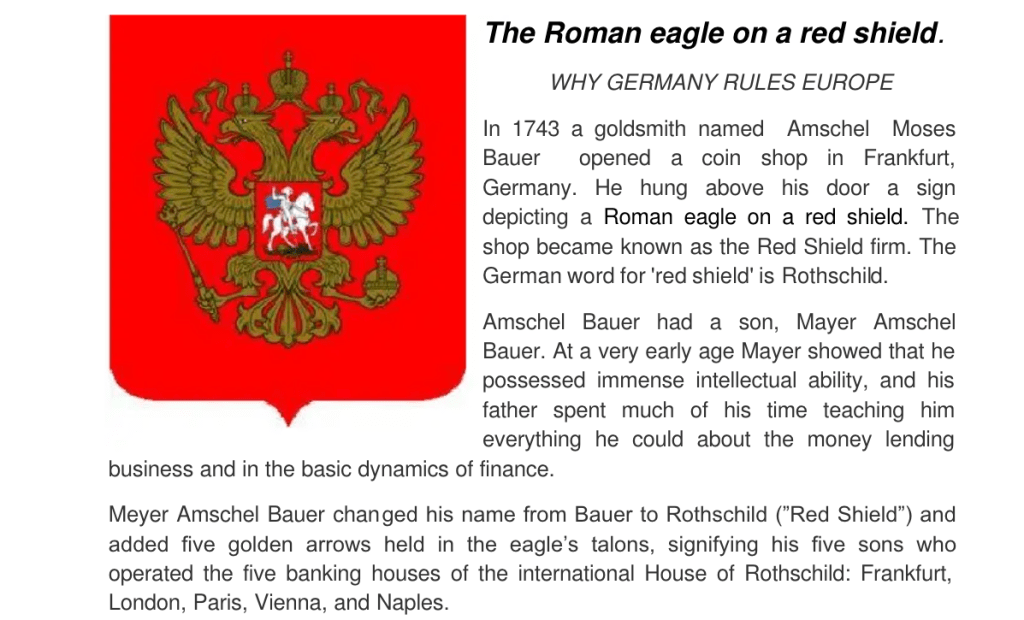
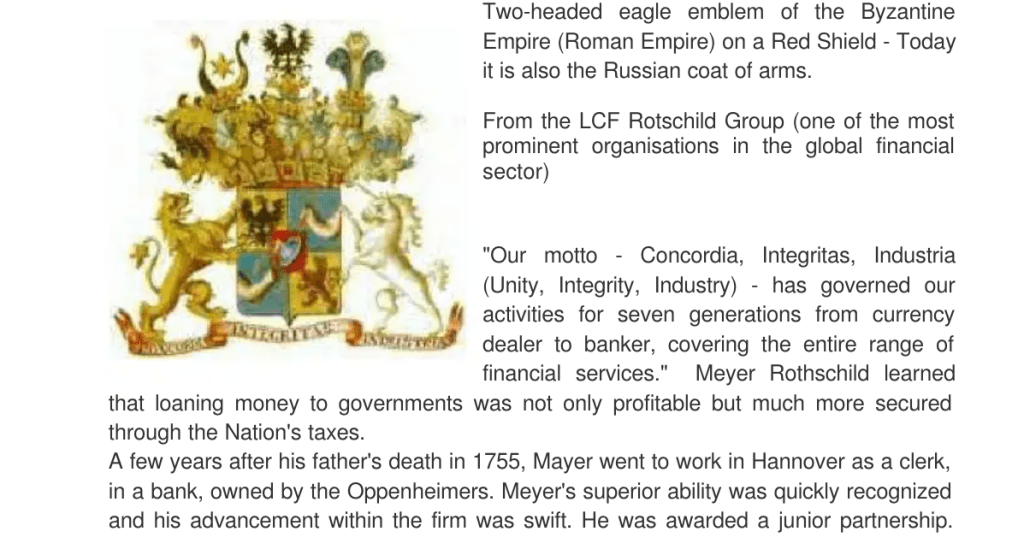
Links in Luciferian Worship
Who was Benjamin Disraeli and the connection to astaroth worship= ROME 325(symbolism connections)?
Benjamin Disraeli, 1st Earl of Beaconsfield, KG, PC, DL, JP, FRS[1] (21 December 1804 – 19 April 1881) was a British statesman, Conservative politician and writer who twice served as Prime Minister of the United Kingdom. He played a central role in the creation of the modern Conservative Party, defining its policies and its broad outreach. Disraeli is remembered for his influential voice in world affairs, his political battles with the Liberal Party leader William Ewart Gladstone, and his one-nation conservatism or “Tory democracy”. He made the Conservatives the party most identified with the British Empire and military action to expand it, both of which were popular among British voters. He is the only British Prime Minister to have been born Jewish. He was also a novelist, publishing works of fiction even as Prime Minister.
Disraeli was born in Bloomsbury, then a part of Middlesex. His father left Judaism after a dispute at his synagogue; Benjamin became an Anglican at the age of 12. After several unsuccessful attempts, Disraeli entered the House of Commons in 1837. In 1846 the Prime Minister at the time, Sir Robert Peel, split the party over his proposal to repeal the Corn Laws, which involved ending the tariff on imported grain. Disraeli clashed with Peel in the House of Commons, becoming a major figure in the party. When Lord Derby, the party leader, thrice formed governments in the 1850s and 1860s, Disraeli served as Chancellor of the Exchequer and Leader of the House of Commons.
Upon Derby’s retirement in 1868, Disraeli became Prime Minister briefly before losing that year’s general election. He returned to the Opposition before leading the party to winning a majority in the 1874 general election. He maintained a close friendship with Queen Victoria who, in 1876, elevated him to the peerage, as Earl of Beaconsfield. Disraeli’s second term was dominated by the Eastern Question—the slow decay of the Ottoman Empire and the desire of other European powers, such as Russia, to gain at its expense. Disraeli arranged for the British to purchase a major interest in the Suez Canal Company in Egypt. In 1878, faced with Russian victories against the Ottomans, he worked at the Congress of Berlin to obtain peace in the Balkans at terms favourable to Britain and unfavourable to Russia, its longstanding enemy. This diplomatic victory over Russia established Disraeli as one of Europe’s leading statesmen.
World events thereafter moved against the Conservatives. Controversial wars in Afghanistan and South Africa undermined his public support. He angered British farmers by refusing to reinstitute the Corn Laws in response to poor harvests and cheap imported grain. With Gladstone conducting a massive speaking campaign, the Liberals defeated Disraeli’s Conservatives at the 1880 general election. In his final months, Disraeli led the Conservatives in Opposition.
Disraeli wrote novels throughout his career, beginning in 1826, and published his last completed novel, Endymion, shortly before he died at the age of 76.
The gods of Greek, Egyptian, and Rome come together in the gods of Europe. (why symbolism is used an important to them)
The Roman eagle and Rome 325 and Egyptian connection(symbolism connections):
This article is about the Roman battle standard. For other uses, see Aquila.
 Roman ornament with an aquila (100–200 AD) from the Cleveland
Museum of Art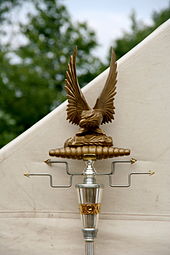 A modern reconstruction of an aquila
An aquila (Classical Latin: [ˈakᶣɪla], lit. ’eagle‘) was a prominent symbol used in ancient Rome, especially as the standard of a Roman legion. A legionary known as an aquilifer, the “eagle-bearer”, carried this standard. Each legion carried one eagle.
The eagle had quasi-religious importance to the Roman soldier, far beyond being merely a symbol of his legion. To lose a standard was extremely grave, and the Roman military went to great lengths both to protect a standard and to recover it if it was lost; after the annihilation of three legions in the Teutoburg Forest, the Romans spent decades retaliating for the defeat while also attempting to recover the three lost eagles.
No legionary eagles are known to have survived. However, other Roman eagles, either symbolizing imperial rule or used as funerary emblems, have been discovered.[1]

Roman imperial eagle from the 2nd century A.D., possibly from Trajan’s Forum, in the outer portico of the Basilica of the Holy Apostles in Rome.
History (symbolism connections)
Main article: Insignia § Ancient Rome
The signa militaria were the Roman military ensigns or standards.[2] The most ancient standard employed by the Romans is said to have been a handful (manipulus) of straw fixed to the top of a spear or pole. Hence the company of soldiers belonging to it was called a maniple. The bundle of hay or fern was soon succeeded by the figures of animals, of which Pliny the Elder (H.N. x.16) enumerates five: the eagle, the wolf, the ox with the man’s head, the horse, and the boar.[3][4] Pliny attributes to the consul Gaius Marius the setting aside of the four quadrupeds as standards and the retention of the eagle (Aquila) alone after the devastating Roman defeat at the Battle of Arausio against the Cimbri and Teutons in 104 BC. It was made of silver, or bronze, with outstretched wings, but was probably of relatively small size, since a standard-bearer (signifer) under Julius Caesar is said in circumstances of danger to have wrenched the eagle from its staff and concealed it in the folds of his girdle.[5] Pliny’s claim is refuted by sources showing late republican and early imperial legions with other animal symbols such as bulls and wolves.[6]
Under the later emperors the eagle was carried, as it had been for many centuries, with the legion, a legion being on that account sometimes called aquila (Hirt. Bell. Hisp. 30). Each cohort had for its own ensign the draco, which was woven on a square piece of cloth textilis anguis,[7] elevated on a gilt staff, to which a cross-bar was adapted for the purpose,[8] and carried by the draconarius.[9]
Another figure used in the standards was a ball (orb), supposed to have been emblematic of the dominion of Rome over the world;[10] and for the same reason a bronze figure of Victoria was sometimes fixed at the top of the staff, as we see it sculptured, together with small statues of Mars, on the Column of Trajan and the Arch of Constantine.[11] Under the eagle or other emblem was often placed a head of the reigning emperor, which was to the army an object of worship or veneration.[12] The name of the emperor, or of him who was acknowledged as emperor, was sometimes inscribed in the same situation.[13] The pole used to carry the eagle had at its lower extremity an iron point (cuspis) to fix it in the ground and to enable the aquilifer in case of need to repel an attack.[14]
The minor divisions of a cohort, called centuries, also each had an ensign, inscribed with the number both of the cohort and of the century. This, together with the diversities of the crests worn by the centurions, enabled each soldier to take his place with ease.[15]
In the Arch of Constantine at Rome there are four sculptured panels near the top which exhibit a great number of standards and illustrate some of the forms here described. The first panel represents Trajan giving a king to the Parthians: seven standards are held by the soldiers. The second, containing five standards, represents the performance of the sacrifice called suovetaurilia.[16]
When Constantine embraced Christianity, a figure or emblem of Christ, woven in gold upon the purple cloth, was substituted for the head of the emperor. This richly ornamented standard was called labarum.[17] The labarum is still used today by the Eastern Orthodox Church in the Sunday service. The entry procession of the chalice whose contents will soon become holy communion is modeled after the procession of the standards of the Roman army.
Eagle and weapons from an Augustan-era funerary monument, probably that of Messalla (Prado, Madrid)
Even after the adoption of Christianity as the Roman Empire’s religion; the eagle continued to be used as a symbol by the Holy Roman Empire and the early Byzantine Empire although far more rarely and with a different meaning. In particular the double-headed eagle, despite strongly linking back to a Pagan symbol, became very popular among Christians.
Since the movements of a body of troops and of every portion of it were regulated by the standards, all the evolutions, acts, and incidents of the Roman army were expressed by phrases derived from this circumstance. Thus signa inferre meant to advance, referre to retreat, and convertere to face about; efferre, or castris vellere, to march out of the camp;[19] ad signa convenire, to re-assemble.[20] Notwithstanding some obscurity in the use of terms, it appears that, whilst the standard of the legion was properly called aquila, those of the cohorts were in a special sense of the term called signa, their bearers being signiferi, and that those of the manipuli or smaller divisions of the cohort were denominated vexilla, their bearers being vexillarii. Also, those who fought in the first ranks of the legion, in front of the standards of the legion and cohorts, were called antesignani.[21]
In military stratagems, it was sometimes necessary to conceal the standards.[22] Although the Romans commonly considered it a point of honour to preserve their standards, in some cases of extreme danger the leader himself threw them among the ranks of the enemy in order to divert their attention or to animate his own soldiers. A wounded or dying standard-bearer delivered it, if possible, into the hands of his general,[24] from whom he had received it signis acceptis.
The “elites” convert to astaroth knowingly…..the surfs (general population)convert to the off set of astaroth which is christianity and all its domination or forms.
Back to the Rothchild’s…. founder and name changer Mayer Amschel Bauer….
https://www.rothschildarchive.org/genealogy/
https://www.geni.com/people/Elchanan-zur-roten-Rose/6000000008101369051
Who was Mayer Amschel Bauer later Mayer Amschel Bauer Rothschild?
I am choosing the 1400s timeline to begin. It is my estimation this is when after several years of the Ottoman empire (brown shirts of Rome 325) had weakened several nations, allowed the true intended conquors to enter and impost force conversation to ROME 325 paganism
Link to timeline of Germany wars: https://en.wikipedia.org/wiki/List_of_wars_involving_Germany
DOB:estimated between 1435 and 1491 Uri Feibesch (Fajsch) zu Bacharach (Bacharach) the great great great great geat great grand father of Mayer Amchel Bauer Rothschild.
DOB:estimated 1496 Isaac (Isaak) Elchanan Bacharach, zum Hahn, zum rot. Schilds the great great great geat great grand father of Mayer Amchel Bauer Rothschild.
DOB: circa 1528 Isaac (Isaak) Elchanan Bacharach, (to the rooster, to the red. shield, )is the great great geat great grand father of Mayer Amchel Bauer Rothschild.
DOB:estimated between 1560 and 1584 Moses Isaac Rothschild Bauer(Mosque Rotschild”, “Mose to the red shield), is great great great grand father of Mayer Amchel Bauer Rothschild.
DOB: estimated between 1555 and 1619 Herz Moses Rothschild Bauer zur hinteren Pfanne, is the great great grandfather of Mayer Amchel Bauer Rothschild.
DOB: 1648 Kalman Herz (Rothschild ) Bauer , zur Hinter Pfann is the great grandfather of Mayer Amchel Bauer Rothschild.
DOB: estimated between 1653 and 1665Moses Kalman Bauer (Moses Bauer”, “Mosche ben Kalman Rothschild) is the grandfather of Mayer Amchel Bauer Rothschild.
Amschel Moses Bauer was the father of Mayer Amchel Bauer Rothschild.
Schönche (née Lechnich)was the mother of Mayer Amchel Bauer Rothschild.
Mayer Amschel Rothschild became the progenitor of the Rothschild dynasty.
And this my friends is only one reason how astaroth has invaded several parts of the world and it institutions…..education , legal, government, financial , trade, business, entertainment and so on.
More videos to watch regarding this topic…
No from here will drive into the video study of …….
The Hebrew People by
Josephine Kamm
video link it pending upload….. sooooo to be continued .
with love,
Marie

Discover more from Rheena Velia Speaks G-D's Grace
Subscribe to get the latest posts sent to your email.

I just could not depart your web site prior to suggesting that I really loved the usual info an individual supply in your visitors Is gonna be back regularly to check up on new posts
LikeLike
I have been surfing online more than 3 hours today yet I never found any interesting article like yours It is pretty worth enough for me In my opinion if all web owners and bloggers made good content as you did the web will be much more useful than ever before
LikeLike
Thank you for the good writeup It in fact was a amusement account it Look advanced to far added agreeable from you However how could we communicate
LikeLike