


|
Hope you are enjoying the BLOG. Please, like, heart, and or share. With Love, Rheena Velia
Getting your Trinity Audio player ready…
|
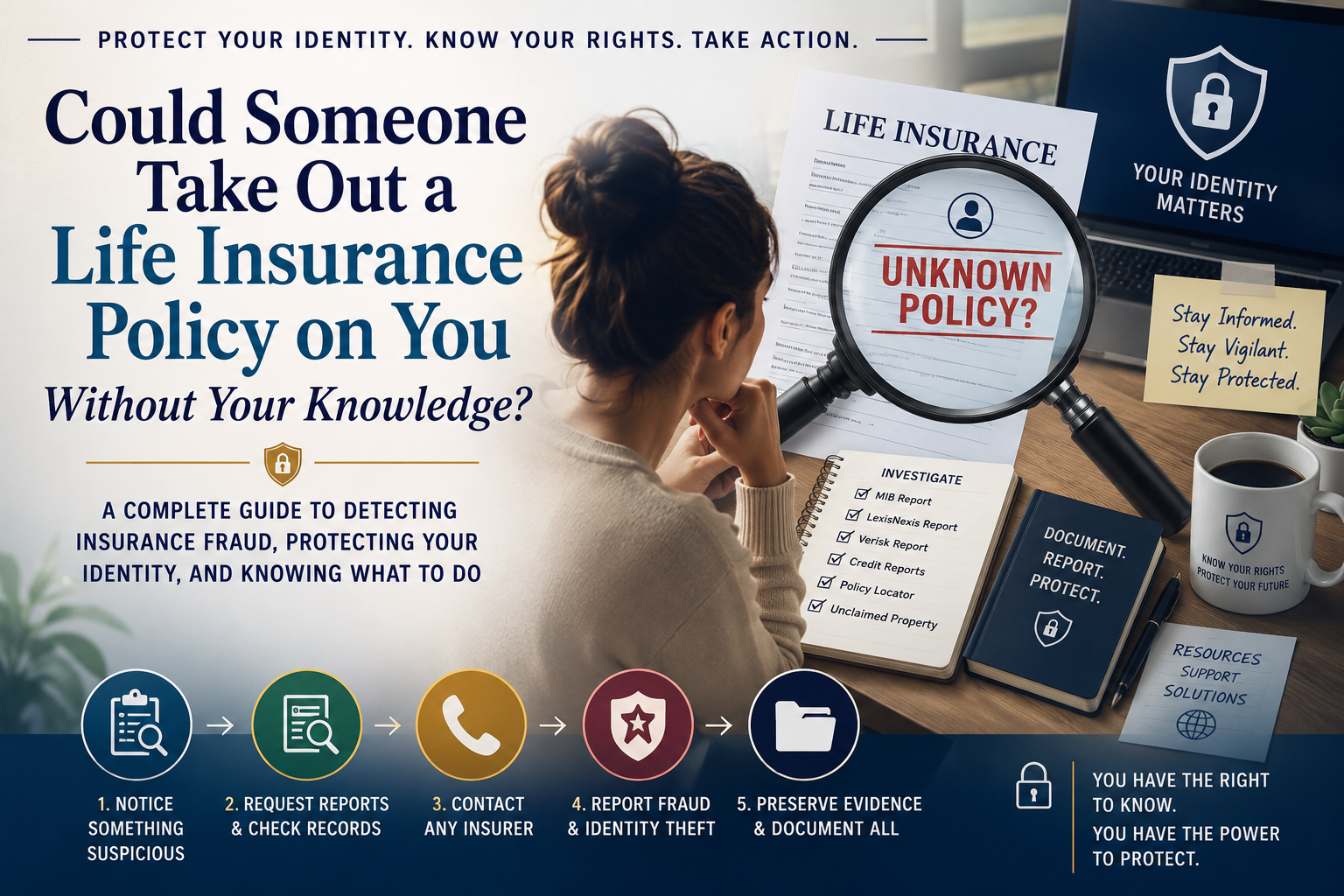
Could Someone Take Out a Life Insurance Policy on You Without Your Knowledge?
A Consumer Guide to Detecting Potential Insurance Fraud and Protecting Your Identity
Life insurance is intended to provide financial protection for loved ones—not to become a vehicle for fraud or identity theft. While it is generally difficult for someone to obtain a life insurance policy on another competent adult without their knowledge and consent, fraudulent schemes do exist. As identity theft has become more sophisticated, regulators and insurers have warned of schemes involving stolen identities, forged signatures, and “Stranger-Originated Life Insurance” (STOLI) arrangements. (NAIC Content)
This article is intended as an educational resource to help consumers understand the warning signs, the tools available to investigate suspicious activity, and the agencies that may be able to assist if fraud is suspected. It is not legal advice, and every situation is unique.
What Is Stranger-Originated Life Insurance (STOLI)?
STOLI refers to arrangements in which a life insurance policy is obtained primarily for the benefit of an investor or third party who lacks a lawful insurable interest in the insured’s life. In many jurisdictions, these arrangements violate public policy because life insurance is intended to protect against genuine financial loss—not to serve as a wager on another person’s life. (GovInfo)
Can Someone Secretly Take Out Life Insurance on You?
In most situations, obtaining a life insurance policy on another competent adult requires:
- The insured person’s knowledge and consent.
- A valid insurable interest at the time the policy is issued.
- Verification of identity.
- Underwriting, which may include access to medical information and other records.
Although these requirements make secret policies uncommon, identity theft, forged documents, and fraudulent applications can occur. The National Association of Insurance Commissioners (NAIC) has noted increasing concerns about criminals using stolen identities and synthetic identities in insurance fraud schemes. (NAIC Content)
Warning Signs That May Warrant Further Investigation
Consider looking into the matter if you notice:
- Unexpected mail from insurance companies.
- Medical records being requested without your knowledge.
- Unknown insurance inquiries.
- Unexplained credit or identity activity.
- Someone asking unusual questions about your health or finances.
- Notification of insurance applications you did not submit.
- Unknown beneficiaries or policy owners.
- Discovery that your personal information has been compromised.
These signs do not necessarily mean a fraudulent life insurance policy exists, but they may justify further investigation.
How to Investigate
Consumers can request reports from several organizations that maintain insurance-related information.
1. Request Your MIB Consumer File
The Medical Information Bureau (MIB) may contain records of life and health insurance underwriting inquiries made by participating insurers.
Request your report:
Consumer Services:
866-692-6901
2. Request Your LexisNexis Consumer Disclosure Report
LexisNexis Risk Solutions maintains insurance-related databases used during underwriting and fraud prevention.
LexisNexis Consumer Disclosure Center
Consumer Center:
866-312-8076
3. Request Your Verisk Consumer Report
Verisk maintains insurance databases used by many insurers.
Verisk Consumer Report Information
4. Review Your Credit Reports
Identity theft frequently affects more than one industry.
Request your free reports:
Look for unfamiliar:
- Addresses
- Employers
- Accounts
- Hard inquiries
5. Search Unclaimed Property
Insurance proceeds occasionally become unclaimed property.
National Association of Unclaimed Property Administrators Search
6. Use the NAIC Life Insurance Policy Locator
If appropriate, use the NAIC’s policy locator service.
NAIC Life Insurance Policy Locator
If You Find a Policy You Did Not Authorize
Immediately contact the insurance company and request:
- A complete copy of the application.
- Policy number.
- Owner information.
- Beneficiary designation.
- Signed consent forms.
- Electronic signature logs.
- Agent information.
- IP address records (if submitted electronically).
- Premium payment history.
- Medical examination records.
- Recorded interviews, if applicable.
Request that all records be preserved while the matter is investigated.
Where to Report Suspected Fraud
Federal Trade Commission
Identity theft reporting:
Phone:
877-438-4338
State Insurance Department
Locate your state’s insurance regulator:
NAIC State Insurance Departments Directory
FBI Internet Crime Complaint Center
If electronic fraud was involved:
Internet Crime Complaint Center (IC3)
Yes. If you believe someone fraudulently obtained a life insurance policy using your identity, forged your consent, or otherwise committed insurance fraud, you may want to consult an attorney who handles consumer protection, insurance fraud, identity theft, fraud litigation, or insurance bad-faith cases. Whether you have grounds to sue or whether criminal charges are appropriate will depend on the facts and evidence. Prosecutors—not private individuals—decide whether to bring criminal charges, but an attorney can help you preserve evidence, pursue civil claims if warranted, and communicate with investigators.
U.S. Postal Inspection Service
For mail theft or mail fraud:
U.S. Postal Inspection Service Report Fraud
Financial Crimes Enforcement Network (FinCEN)
For suspected financial crimes:
Financial Crimes Enforcement Network (FinCEN)
Notable Court Decisions
Several courts have addressed fraudulent life insurance schemes involving lack of insurable interest or fraudulent procurement:
- New Stream Insurance, LLC v. PHL Variable Insurance Co. (8th Cir. 2011) discussed STOLI schemes and upheld rescission of a fraudulently procured policy. (GovInfo
)
- Lincoln National Life Insurance Co. v. Imperial Premium Finance Co. (11th Cir. 2015) examined financing arrangements designed to circumvent insurable-interest requirements. (Justia Law
)
- Estate of Malkin v. Wells Fargo Bank (11th Cir. 2021) affirmed that a policy lacking a valid insurable interest could be declared void under applicable law. (Justia Law
)
These cases illustrate that courts have scrutinized and, in appropriate circumstances, invalidated policies procured through fraud or in violation of insurable-interest laws.

Here are some firms that may be worth contacting based on their publicly described practice areas:
- Consumer Justice Law Firm – Focuses on consumer protection and has experience with identity theft and credit reporting disputes.
- Bybee Law Center, PLC – Consumer law practice that states it handles identity theft, credit reporting, and consumer-related litigation.
- Arizona Credit Lawyers – Focuses on identity theft, credit reporting errors, debt collection, and Fair Credit Reporting Act (FCRA) issues.
- Bonnett, Fairbourn, Friedman & Balint, P.C. – Handles consumer fraud and insurance-related litigation.
- Christian, Dichter & Sluga, P.C. – Has an insurance litigation practice and experience with insurance law.
- Ryan Rapp Pacheco Sorensen, PLC – Handles complex litigation, including insurance-related disputes.
In addition to speaking with an attorney, you should consider reporting suspected fraud to the appropriate agencies:
- Arizona Department of Insurance and Financial Institutions (DIFI) – Investigates insurance fraud and consumer complaints. Arizona DIFI Insurance Fraud Reporting
- Federal Trade Commission (FTC) – File an identity theft report and receive a recovery plan. IdentityTheft.gov
- FBI Internet Crime Complaint Center (IC3) – Appropriate if online fraud, email fraud, or electronic identity theft was involved.
- Your local law enforcement agency, if you believe crimes such as identity theft, forgery, or fraud occurred.
When you contact an attorney, it’s helpful to bring:
- Your MIB report.
- LexisNexis and Verisk reports (if obtained).
- Any correspondence from insurers.
- Any suspected fraudulent applications or policy information.
- Identity theft reports, police reports, or FTC reports.
- A timeline of events and copies of supporting documents.
Additional Considerations and Frequently Asked Questions
Understanding the Normal Life Insurance Process
For most individually purchased life insurance policies, insurers require the applicant to verify their identity, provide personal and medical information, and, in many cases, obtain the knowledge and consent of the insured adult. Depending on the type and amount of coverage, the insurer may also conduct medical underwriting, review prescription history, access consumer reporting databases, or require a medical examination.
Many insurers also use electronic application systems that create records such as:
- Electronic signature logs
- IP address information
- Device and browser information
- Email verification records
- Telephone interview recordings
- Agent notes and underwriting documentation
If questions later arise regarding how a policy was obtained, these records may become important during an investigation.
What Evidence Should You Preserve?
If you suspect identity theft or insurance fraud, maintaining organized records can make a significant difference. Consider keeping copies of:
- All correspondence with insurance companies
- Emails and text messages
- Certified mail receipts
- Screenshots of online accounts or communications
- Your MIB Consumer File
- LexisNexis Consumer Disclosure Report
- Verisk Consumer Report
- Credit reports
- Police reports
- FTC Identity Theft reports
- Complaint confirmation numbers
- Notes documenting dates, times, and names of individuals you speak with
Creating a chronological timeline of events can also help investigators and legal professionals better understand your concerns.
Questions You May Wish to Ask an Insurance Company
If you discover an unfamiliar policy or application, consider requesting information such as:
- Who owns the policy?
- Who is listed as the beneficiary?
- When was the policy issued?
- Who submitted the application?
- Was the application completed online or in person?
- Which email address and phone number were used?
- What mailing address is on file?
- Who paid the premiums?
- Was a medical examination performed?
- Is there a recorded verification interview?
- Which insurance agent or producer handled the application?
- Are electronic signature records available?
- Are IP address or login records available?
Not every insurer will release every record, but it is reasonable to ask what documentation exists and what can be provided under applicable law.
Frequently Asked Questions
Can someone legally purchase life insurance on me without my knowledge?
In many situations, insurers require the knowledge and consent of a competent adult insured. However, laws vary by state, and there are exceptions, such as certain employer-sponsored group life insurance plans or other situations authorized by law.
Does an MIB report show every life insurance policy?
No. MIB is a member organization, and not every insurer participates. An MIB report should be viewed as one investigative resource rather than a complete record of all life insurance activity.
Will a life insurance policy appear on my credit report?
Generally, no. However, identity theft associated with an insurance application may also involve fraudulent credit activity, making it worthwhile to review your credit reports.
Can I request a copy of an insurance application?
If you believe an application was submitted using your identity, you may ask the insurer what records are available and what documentation they can provide under applicable law.
How long should I keep my records?
If an investigation or legal proceeding is ongoing, consider retaining copies of all documents until the matter has been fully resolved. If you are unsure how long to keep records, consult a qualified attorney regarding your specific circumstances.
What This Article Does Not Mean
This article is intended to educate consumers about life insurance, identity theft, and potential insurance fraud. It should not be interpreted to mean that every insurance inquiry, underwriting record, or unfamiliar communication indicates fraud.
There are many legitimate reasons an insurance company may access consumer reporting databases or request information during the normal underwriting process. Likewise, an MIB record, LexisNexis report, or insurance inquiry does not, by itself, prove that a policy exists or that any wrongdoing has occurred.
If you notice unusual activity, gather information carefully, request available records, and allow the appropriate insurer or regulatory agency to investigate before reaching conclusions. Careful documentation, patience, and reliance on verified facts are often the most effective approach.
Additional Resources
The following organizations provide educational materials, consumer assistance, and reporting resources:
- National Association of Insurance Commissioners (NAIC)
- Medical Information Bureau (MIB)
- LexisNexis Risk Solutions Consumer Center
- Verisk Consumer Services
- Federal Trade Commission (IdentityTheft.gov)
- FBI Internet Crime Complaint Center (IC3)
- U.S. Postal Inspection Service
- Your state’s Department of Insurance or Insurance Commissioner
- Your state’s Attorney General Consumer Protection Division
These organizations can provide information about consumer rights, reporting procedures, and available resources if you believe you may be the victim of identity theft or insurance-related fraud.
Knowledge is one of the strongest tools consumers have. Understanding how the life insurance process works, recognizing potential warning signs, and knowing where to seek reliable information can help you protect your identity and make informed decisions if concerns arise.
Final Thoughts
Identity theft and insurance fraud continue to evolve as criminals develop increasingly sophisticated methods. While the vast majority of life insurance policies are issued lawfully, consumers should not ignore unexplained insurance activity or signs that their personal information may have been misused.
Maintaining copies of your reports, monitoring your personal information, and acting promptly if something appears suspicious can help protect both your financial interests and your identity. If you believe a policy was obtained through fraud or without your lawful consent, document everything, notify the insurer, report the matter to the appropriate agencies, and consider consulting a qualified attorney regarding your specific circumstances.
Disclaimer
This article is provided for general educational and informational purposes only and should not be construed as legal, financial, or insurance advice. Laws governing life insurance, insurable interest, fraud, and consumer rights vary by jurisdiction. Reading this article does not create an attorney-client relationship. If you believe you are the victim of identity theft, insurance fraud, or another crime, contact the appropriate authorities and seek advice from a licensed attorney or other qualified professional.
With love and educational support,
Rheena Velia

Leave a Reply