

|
Hope you are enjoying the BLOG. Please, like, heart, and or share. With Love, Rheena Velia
Getting your Trinity Audio player ready…
|
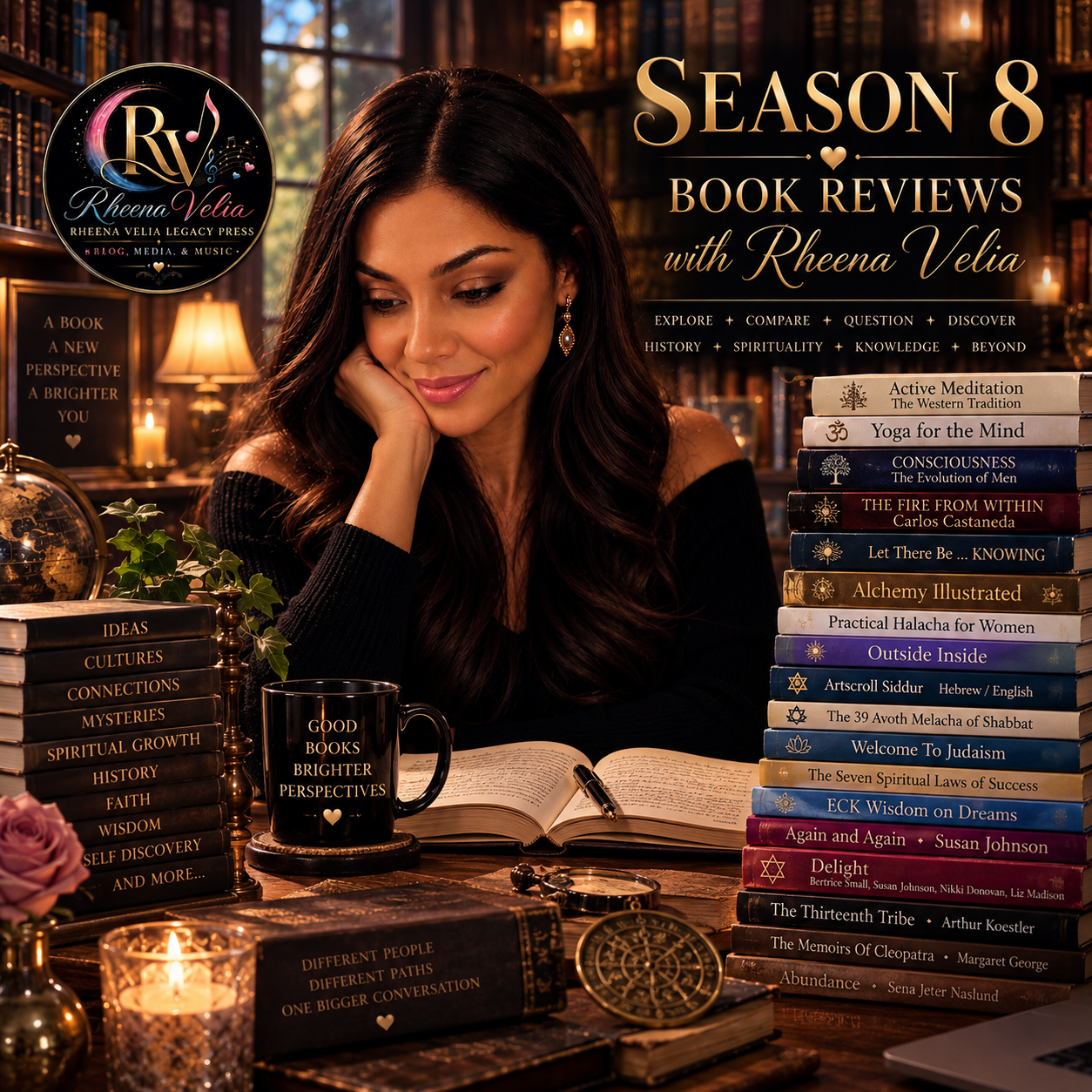
Rheena Velia Legacy Press — Season 8 Book Reviews | Subscribers Only
A New Season, A Deeper Conversation
There are books we read, books we study, books we question-and then there are books that seem to open a door. Season 8 of Rheena Velia Legacy Press Book Reviews is about walking through those doors and taking a closer look at what we find on the other side. This season, I, Rheena Velia, will be bringing subscribers a collection of book reviews, commentary, research, symbolism, feature images, visual cheat sheets, historical connections, cultural comparisons, and conversations designed to encourage readers to look beyond the surface of a book and ask better questions. Some books may challenge us. Some may inspire us. Some may frustrate us. Some may introduce ideas that deserve deeper investigation. And some may simply make us stop, turn the page backward, and say, “Wait…what did I just read?”
What Rheena Velia Likes……. Books and about the Author
That is exactly where I want Season 8 to live.
This will not be a traditional “five stars or one star” review series where a book is reduced to a simple rating. A book can be beautifully written and still contain ideas worth questioning. A book can have historical value without every interpretation within it being historically established. A book can be controversial and still deserve to be read critically. A spiritual, mystical, esoteric, historical, cultural, or metaphysical book can be fascinating without every claim inside it being presented as proven fact. My goal is to create a space where curiosity and discernment can exist together.
And yes—the feature images are part of the conversation.
What Is Rheena Velia Legacy Press Book Reviews?
Season 8 will explore books through a broader editorial lens.
Rather than simply asking:
“Did I like this book?”
I want to ask:
- What is this book actually saying?
- What sources does the author use?
- What traditions or historical periods does it draw from?
- What symbols appear throughout the work?
- What assumptions does the author make?
- What can be independently verified?
- Where does documented history end and interpretation begin?
- What ideas are ancient?
- What ideas are modern?
- What has been borrowed, adapted, renamed, or reinterpreted?
- What questions does the book leave unanswered?
- What questions does it make us want to investigate next?
- And perhaps most importantly: what does the reader do with the information after closing the book?
That last question matters.
Information without discernment can become misinformation very quickly.
The internet has made it easier than ever to encounter fascinating claims, beautiful graphics, ancient symbols, spiritual systems, historical theories, alternative interpretations, and viral “facts.” It has also made it easier for inaccurate information to travel just as quickly as accurate information.
Season 8 will therefore be interested in the space between curiosity and verification.
The Feature Images: More Than Pretty Pictures
If you have been following my work, you already know that I enjoy turning complicated subjects into visual references.
For Season 8, I will continue developing feature images that function as visual cheat sheets, symbolic maps, and conversation starters.
You may see images covering subjects such as:
- Tarot cards
- Major Arcana and Minor Arcana
- Tarot symbolism
- Astrology
- Zodiac signs and dates
- Planetary correspondences
- Moon phases
- Days of the week
- Colors associated with different days or traditions
- Frequency concepts
- Historical symbolism
- Cultural calendars
- Mythological figures
- Spiritual traditions
- Comparative symbolism
- Ancient civilizations
- Numerology
- Esoteric traditions
- Book themes
- Authors and literary subjects
- And visual connections that emerge from individual books reviewed during the season
The purpose of these AI created images is not to replace the book.
They are designed to help readers see the conversation.
A good visual reference can take something that requires several pages of explanation and give the reader a framework for remembering the major ideas.
Think of them as the doorway before the deeper discussion.
The Tarot Cheat Sheet

One of the feature-image concepts being developed for this season is a tarot reference guide.
Tarot is particularly interesting because its history is much more complicated than the modern stereotype of “fortune-telling cards.”
The Metropolitan Museum of Art notes that the earliest references to tarot date to the 1440s and 1450s in northern Italian cities including Venice, Milan, Florence, and Urbino. Early tarot was connected to card playing, with Italian suits including Cups, Swords, Batons, and Coins, alongside additional trump cards and the Fool. (The Metropolitan Museum of Art)
That historical background matters because modern tarot culture often projects later occult interpretations backward onto the Renaissance.
Those are not necessarily the same thing.
A tarot card can simultaneously be studied as:
art + history + symbolism + playing-card tradition + later occult interpretation + modern spiritual practice.
Those layers should not automatically be treated as interchangeable.
That distinction will be important throughout Season 8.
When a feature image presents a tarot card with a particular symbolic meaning, the graphic should be understood as a reference to an interpretive tradition, not necessarily as a claim that every historical tarot practitioner understood the card in precisely that way.
This is especially important when discussing Major Arcana cards such as:
The Fool, The Magician, The High Priestess, The Empress, The Emperor, The Hierophant, The Lovers, The Chariot, Strength, The Hermit, Wheel of Fortune, Justice, The Hanged Man, Death, Temperance, The Devil, The Tower, The Star, The Moon, The Sun, Judgment, and The World.
Different decks, schools, authors, and readers can emphasize different meanings.
That is part of what makes tarot so interesting.
The cards themselves have histories.
The interpretations have histories.
And sometimes those histories are not identical.
Astrology & Tarot: Where the Stars Meet the Cards

Another Season 8 feature image explores the relationship between the Western zodiac and tarot.
This is where things get especially interesting.
Modern tarot readers frequently connect particular Major Arcana cards with zodiac signs or planetary principles. These correspondences are influential within certain occult and esoteric systems, but they should not automatically be mistaken for evidence that fifteenth-century tarot was originally designed according to the modern correspondence system.
That distinction is worth making because tarot’s documented early history and its later occult history developed across different periods. The Metropolitan Museum of Art specifically notes that the association of tarot with fortune-telling and occult practices gained currency later, rather than being the original purpose of medieval tarot. (The Metropolitan Museum of Art)
So when I create a graphic showing a relationship such as:
Aries → The Emperor
or
Leo → Strength
or
Aquarius → The Star
the image is functioning as a correspondence chart.
It is not intended to erase the historical complexity of tarot.
Instead, it gives readers a starting point for exploring how later symbolic systems connected the cards with astrology.
And that leads us to one of the most fascinating questions Season 8 will repeatedly ask:
When did this connection appear, and why?
Astrology Is Not One Single System
The word “astrology” can make people think there is one universal system with one set of rules.
There isn’t.
Astrological traditions have developed in different cultures, historical periods, philosophical systems, and religious environments.
That means a Season 8 graphic comparing systems must be read as a comparative reference, not as a claim that every culture practiced astrology in exactly the same way.
Western astrology has the familiar twelve-sign zodiac.
Chinese astrology uses a twelve-animal cycle connected with a much larger calendrical system.
Ancient Egyptian astronomical and calendrical traditions developed their own relationships with the heavens.
Mesoamerican civilizations developed sophisticated calendrical and celestial systems, including the Central Mexican 260-day ritual calendar known as the Tonalpohualli. Modern scholarship continues to investigate the mathematics and structure of that calendar. (arXiv)
Biblical Hebrew, Israelite, and Judaism (religion) history also contains a complicated relationship with astrology and the stars.
That complexity deserves particular respect.


Judaism, the Stars & the Question of “Mazal”
One of the most important cautions for this season concerns the use of the phrase “Judaism astrology.”
There is no single, universally accepted Jewish astrological system that can simply be placed beside Western astrology as though the two developed in exactly the same way.
Judaism sources contain historical discussions of astrology, astronomy, constellations, planetary influences, calendars, and prognostication, while Judaism thinkers have also strongly disagreed about the legitimacy and meaning of astrology.
The Jewish Encyclopedia documents extensive historical Jewish engagement with astrology, including medieval Jewish astrologers and debates over astrology’s legitimacy. It also records the strong opposition of Maimonides to astrology. (Jewish Encyclopedia)
The Orthodox Union similarly discusses the complicated Jewish relationship with astrology and emphasizes the concept that human beings are not simply prisoners of the stars. (Orthodox Union)
That is why any Season 8 graphic touching on Judaism, mazalot, the zodiac, Kabbalistic symbolism, or Judaism mystical traditions should be approached with care.
There is a difference between saying:
“Jewish people have historically discussed astrology.”
and saying:
“Judaism teaches this particular astrological system.”
One is a actual DNA ethnic group. One is a religion.
Those statements are not equivalent.
Season 8 will respect that distinction based of actual evidence and historical truth. Rather then a general applied fallacy of the 90%.
For example:
Hebrew – עִבְרִי (Ivri)
Definition: An ancient designation used in the Hebrew Bible for Abram and, later, for people associated with the Israelites. The first biblical occurrence is Genesis 14:13, where Abram is called “Abram the Hebrew” (Avram ha-Ivri).
The precise origin of Ivri is debated. A traditional/linguistic explanation connects it with the Hebrew root associated with crossing or passing over, giving the sense of someone “from the other side” or one who crossed over. The Septuagint’s ancient Greek rendering of Genesis 14:13 similarly presents Abram as one who crossed over. Scholars have also discussed possible relationships between “Hebrew” and the ancient Near Eastern Habiru/Apiru, but these groups cannot simply be equated with the biblical Hebrews.
Important distinction: “Hebrew” is much older as a biblical designation than “Judaism” as the name of a religious-cultural system. Today, Hebrew most commonly refers to the Hebrew language, although “the Hebrews” remains a historical/biblical designation.
Who Were the Hebrews? – TheTorah.com
Israel / Israelite – יִשְׂרָאֵל (Yisrael)
Definition: In the biblical narrative, Israel is the name given to Jacob in Genesis 32:28. His descendants become the “children of Israel” or Israelites, associated with the twelve tribes.
“Israelite” is therefore fundamentally a peoplehood/ancestral and historical designation in true ancient contexts. It can also refer to inhabitants of ancient Israel, depending upon the historical period being discussed.
We also have exceptionally important evidence outside the Bible. The Egyptian Merneptah Stele, generally dated to around 1208/1207 BCE, contains what is widely regarded as the earliest known extrabiblical textual reference to “Israel.” Significantly, the Egyptian writing identifies Israel as a people rather than a city or territorial state.
So, by approximately 1208 BCE, there was already a group recognizable to the Egyptians by the name Israel.
University of Chicago – Ancient Israel and the Merneptah Stele
Jew / Jewish – יְהוּדִי (Yehudi)
Definition: “Jew” ultimately comes from Hebrew Yehudi, related to Yehudah – Judah. Originally, the terminology could indicate someone associated with Judah, meaning a Judahite/Judean. Its meaning broadened historically.
This is one place where translation deserves special care. Depending upon the period and passage, Yehudi/Ioudaios can sometimes appropriately be understood as “Judean” rather than the modern English conception of “Jew.”
The biblical term is already attested before the Babylonian exile. For example, 2 Kings 16:6 contains Yehudim. The term becomes especially prominent in later biblical literature such as Esther, Ezra and Nehemiah.
Esther provides a fascinating example. Mordecai is called an ish Yehudi in Esther 2:5 while the same verse identifies his ancestry with Benjamin. This demonstrates why Yehudi eventually cannot be understood simply as “biological descendant of the tribe of Judah.”
Over time, “Jew/Jewish” incorrectly became applied to a much broader designation encompassing a people with revisionist claiming shared historical, ancestral, cultural and religious traditions.
Jewish Not Judean: The Diaspora in the Book of Esther
Judaism – Ἰουδαϊσμός (Ioudaismos)
Definition: Judaism is different from the first three terms because it primarily names a religious-cultural tradition or system rather than simply naming an ancient people.
The word has an especially interesting history. The Greek term Ioudaismos appears in 2 Maccabees, generally dated to the second century BCE. This is regarded as the first recorded textual occurrence of the term that eventually gives us “Judaism.” It occurs in passages including 2 Maccabees 2:21, 8:1 and 14:38.
But there is a warning for modern readers: ancient Ioudaismos did not necessarily mean “Judaism” in precisely the modern sense of a religion separate from nationality, culture and peoplehood. In 2 Maccabees it appears in a world where Ioudaismos is contrasted with Hellenismos – Jewish/Judean ancestral ways versus Hellenizing Greek cultural practices. Scholars therefore debate whether “Judaism,” “Judeanism,” or a broader idea of Jewish ancestral practice best captures its ancient meaning.
Academic study of Ioudaismos and its use in Maccabean literature
Quick compare and contrast
| Term | Original form | Basic historical meaning | Approximate early evidence |
|---|---|---|---|
| Hebrew | Ivri / עִבְרִי | Ancient designation for Abram and later Israelites; etymology debated | Genesis 14:13 is its first biblical occurrence |
| Israel / Israelite | Yisrael / יִשְׂרָאֵל | Israel and the people/descendants identified with Israel | Biblical tradition; “Israel” independently attested on Merneptah Stele c. 1208/1207 BCE |
| Modern Jew / Jewish | Yehudi / יְהוּדִי | Claims to connected with Judah/Judea; eventually broader Jewish peoplehood | Pre-exilic biblical usage; increasingly prominent in post-exilic texts |
| Judaism | Ioudaismos / Ἰουδαϊσμός | “Jewish”/Judean religious-cultural tradition and ancestral way of life | -claims- First recorded in 2 Maccabees, 2nd century BCE |
The key idea for your Season 8 article could therefore be:
Hebrew → ancient designation
Israelite → ancient people/national identity
Jew/Jewish → claims to be develops from Judah/Judea into a broader peoplehood identity
Judaism → religious-cultural tradition associated with the religiously proclaimed Jewish people
That does not mean history followed a perfectly straight sequence of “Hebrew became Israelite, Israelite became Jew, Jew became Judaism.” The terms overlap, coexist and depending on politics change meaning. In particular, Judaism is not simply a newer ethnic name for Israelites. It belongs to a different category of description. One is a religion. One is DNA.
One other distinction may be especially useful for your blog: Jewish can describe ancestry, peoplehood, culture or religious identity, whereas Judaism specifically refers to the religious tradition. Therefore, “Jewish ancestry” and “practicing Judaism” are related concepts, but they are not definitions of the same thing. Someone’s religious affiliation and someone’s biological/genealogical ancestry are separate questions.
| Order | Term | Approximate date | What the date represents |
|---|---|---|---|
| 1 | Hebrew / Ivri (עברי) | 2nd millennium BCE in the biblical setting | The Hebrew Bible applies Ivri to figures such as “Abram the Hebrew” (Genesis 14:13). Dating the composition of these passages and the historical origin of the designation is debated. |
| 2 | Israel / Israelite | c. 1208 BCE | The Merneptah Stele provides the earliest generally accepted extrabiblical reference to a people called Israel. |
| 3 | Yehudi / Jew (יהודי) | 1st millennium BCE, certainly by the monarchic/exilic periods | Yehudi originally had an association with Judah/Judea and gradually acquired the broader meaning from which “Jew” ultimately claims to derive. |
| 4 | Judaism / Ioudaismos (Ἰουδαϊσμός) | 2nd century BCE | The Greek term Ioudaismos occurs in 2 Maccabees. Its ancient meaning should not automatically be assumed to correspond perfectly to the modern concept of “Judaism” as a discrete religion. |
| 5 | Jewish | Ancient concept, but English word is medieval | “Jewish” is the English adjective derived from “Jew.” Today it claims to refer to religious, cultural, communal, “historical”, familial, or “ancestral” matters depending on context. |
| 6 | Semitic / Semite | late 18th century CE | European scholars developed “Semitic” as a classification for a family of ancient and modern related languages. The languages are ancient, but “Semitic” as this scholarly category is modern. |
| 7 | Zionism | c. 1890 CE | Nathan Birnbaum is generally credited with introducing the term “Zionism”; organized political Zionism developed during the 1890s, with the First Zionist Congress held in 1897. |
Books and historians to look at that discuss both sides for comparison.
- Arthur Koestler – The Thirteenth Tribe: The Khazar Empire and Its Heritage (1976)
This is the book that popularized the phrase “Thirteenth Tribe.” Koestler argued that the Khazars converted to Judaism and proposed that Khazar descendants later contributed substantially to Eastern European/Ashkenazi Jewry. That latter ancestry thesis is controversial and should not be presented as established historical or genetic fact.
The Thirteenth Tribe – Google Books
- D. M. Dunlop – The History of the Jewish Khazars (1954)
This is an important scholarly work that predates Koestler. Dunlop examined Arabic, Persian, Hebrew, Byzantine and other historical sources concerning the Khazar state and its relationship with Judaism.
Koestler relied substantially on Dunlop, but Dunlop was considerably more cautious than Koestler about the conclusions that could be drawn from the evidence.
- Peter B. Golden – Khazar Studies and The World of the Khazars
Golden is one of the major modern historians of Turkic and Eurasian history. His scholarship is especially useful if you want something academically stronger than Koestler.
Important works include:
- Khazar Studies: An Historico-Philological Inquiry into the Origins of the Khazars
- “The Conversion of the Khazars to Judaism”
- The World of the Khazars: New Perspectives, edited by Peter B. Golden, Haggai Ben-Shammai and András Róna-Tas
The latter came from an international Khazar colloquium and includes scholarship from multiple specialists rather than advancing a single “13th Tribe” theory.
Encyclopaedia Iranica’s extensive Khazar article and scholarly bibliography
- Norman Golb and Omeljan Pritsak – Khazarian Hebrew Documents of the Tenth Century (1982)
This is particularly useful because it moves closer to primary-source material.
Golb and Pritsak studied Hebrew documents connected with the Khazar world, including the famous Kyiv/Kievan Letter. Their work is important for studying Jewish presence and Hebrew documentary evidence connected to Khazaria rather than starting with modern ancestry theories.
The National Library of Israel catalogs the book among major works concerning Khazar history and sources.
- Omeljan Pritsak – “The Khazar Kingdom’s Conversion to Judaism” (1978)
Pritsak was a historian and specialist in Eurasian history. His article specifically examines the question of the Khazar ruling elite’s adoption of Judaism.
It appeared in Harvard Ukrainian Studies and is included in the scholarly bibliography on Khazar history.
- Abraham N. Poliak – Khazaria: History of a Jewish Kingdom (1951, Hebrew)
Poliak is especially relevant to your question because his work was one of the predecessors to Koestler’s theory.
Poliak argued for significant connections between Khazaria and later Eastern European Jewish populations. Koestler subsequently drew upon Poliak’s work.
Because of that, I would categorize Poliak and Koestler together as important for understanding the development of the “Khazar ancestry” hypothesis, rather than treating their conclusions as the present scholarly consensus.
- Shaul Stampfer – “Did the Khazars Convert to Judaism?”
This one is important because Stampfer argues strongly against even one of the foundational assumptions of the traditional Khazar narrative.
He reexamined the historical sources and concluded that the evidence does not adequately establish the traditional account of a Khazar conversion to Judaism. That conclusion itself has been debated by other scholars, so it gives you an excellent compare-and-contrast source.
National Library of Israel – Did the Khazars Convert to Judaism?
Chinese Astrology: More Than an Animal
The Chinese zodiac is another area where a simple graphic can become misleading if we don’t explain what we’re looking at.
People often know the twelve animals:
Rat, Ox, Tiger, Rabbit, Dragon, Snake, Horse, Goat, Monkey, Rooster, Dog, Pig.
But the animal is only part of the broader calendrical framework.
This is precisely why Season 8 feature graphics will be treated as introductions rather than exhaustive explanations.
A graphic can help you remember the twelve-animal cycle.
A book can help you investigate the history.
And research can help you understand the system beyond the popularized version.
That three-step process is exactly what I want Season 8 to encourage:
See it. Question it. Research it.
For example:
Chinese Astrology – Brief Definition
Chinese astrology is a collection of traditional Chinese systems for interpreting relationships between celestial phenomena, calendrical cycles, time, nature, political events, and human affairs.
It is much broader than the familiar “What Chinese zodiac animal are you?” system popular today. Historically, Chinese astrology was closely intertwined with astronomy, calendars, mathematics, divination, imperial government, and Chinese cosmological concepts such as yin and yang and the Five Phases.
Historian of science Donald Harper places astrology and calendrical thought within the broader development of Chinese cosmology, particularly from roughly the fifth century BCE through the second century CE.
How old is it?
There isn’t one date on which “Chinese astrology” suddenly began.
Chinese observation and interpretation of celestial phenomena developed over many centuries. Astronomical and cosmological traditions existed in ancient China long before the complete twelve-animal zodiac appeared in surviving records.
Historian David W. Pankenier notes that Chinese concern with astronomical phenomena reaches back to the beginnings of Chinese civilization. He points to Sima Qian, the famous Han historian and court astrologer around 100 BCE, whose Records of the Grand Historian contains a major treatise concerning celestial phenomena.
This is an important distinction for the blog:
Chinese astronomy/astrology ≠ Chinese animal zodiac.
The animal zodiac is only one component of a much larger system.
The 12 Chinese Zodiac Animals – 生肖 (Shengxiao)
The familiar cycle is:
Rat – Ox – Tiger – Rabbit – Dragon – Snake – Horse – Goat/Ram – Monkey – Rooster – Dog – Pig.
The cycle repeats every twelve years.
The Metropolitan Museum of Art reports that by the Eastern Han dynasty (25-220 CE), the conventional sequence of the twelve animals was firmly established. The Met also identifies first-century Eastern Han evidence as the earliest known record of the zodiac animals in their familiar sequence.
The Metropolitan Museum of Art – Twelve Zodiac Animals
Interestingly, archaeological/art-historical evidence develops further afterward. The Met notes representations of the twelve animals in a tomb dated 533 CE, while zodiac figures became particularly popular as tomb objects during the Tang dynasty (618-907).
So a simplified timeline would be:
Ancient celestial observation → calendrical systems → stems and branches → animal associations → established twelve-animal zodiac by the Eastern Han → widespread artistic and popular representations in later dynasties.
Heavenly Stems and Earthly Branches
This is where Chinese astrology becomes much more interesting than the modern restaurant-place-mat zodiac.
Two important systems are:
10 Heavenly Stems – 天干 (Tiāngān)
12 Earthly Branches – 地支 (Dìzhī)
The twelve Earthly Branches eventually became associated with the twelve zodiac animals.
Combining the stems and branches produces the traditional 60-unit sexagenary cycle.
The Met explains that the twelve animals were paired with calendrical elements to produce a repeating sixty-year system used for counting years in China into the twentieth century.
That means saying:
“I was born in the Year of the Dragon”
captures only one portion of the traditional calendrical system.
Yin and Yang – 陰陽
Yin and Yang are complementary principles used within traditional Chinese cosmological thought.
They should not simply be translated as “good versus evil.”
Instead, they concern complementary or alternating characteristics and processes within the cosmos.
Donald Harper’s history of ancient Chinese science discusses the development of correlative cosmology in which qi and cyclical processes of yin and yang became important ways of understanding nature and the universe.
Oxford Academic – Science in Ancient China
Five Phases – 五行 (Wuxing)
Often translated in popular Western books as the “Five Elements,” Wuxing literally carries more of a sense of five phases/processes.
They are:
| Phase | Chinese | Common translation |
|---|---|---|
| Wood | 木 | Wood |
| Fire | 火 | Fire |
| Earth | 土 | Earth |
| Metal | 金 | Metal |
| Water | 水 | Water |
These became part of a much broader Chinese system of correspondences involving seasons, directions, colors, celestial phenomena, medicine, calendars and other classifications.
This is another reason I would avoid defining Chinese astrology simply as “12 animals representing personality.”
Fate Calculation – Four Pillars
Another tradition is commonly called the Four Pillars of Destiny or Bazi:
八字 – Bāzì, literally “Eight Characters.”
Calculations can incorporate:
Year
Month
Day
Hour
The resulting combinations of stems and branches are traditionally interpreted to construct a person’s fate calculation.
A useful older scholarly study is Chao Wei-pang’s 1946 article “The Chinese Science of Fate-Calculation.” It specifically examines the historical development of fate calculation, the Five Phases, stems and branches, Four Pillars, and changes in these practices before and after the Song dynasty.
JSTOR – The Chinese Science of Fate-Calculation
Historians and Books for Your Sources
One historian I would definitely include is Ho Peng Yoke (1926-2014), a major historian of Chinese science.
1. Ho Peng Yoke – Chinese Mathematical Astrology: Reaching Out to the Stars
This is probably one of the strongest books for what you’re researching.
Rather than being a modern “find your zodiac personality” book, it approaches Chinese astrology historically.
Ho examines three sophisticated systems collectively known as sanshi, or “three cosmic boards”:
Taiyi
Qimen Dunjia
Liuren
These systems were used by the Chinese Astronomical Bureau and could be applied to subjects including weather, warfare, state affairs and human events.
Routledge – Chinese Mathematical Astrology
Google Books – Chinese Mathematical Astrology
2. David W. Pankenier – Astrology and Cosmology in Early China: Conforming Earth to Heaven
Pankenier is particularly useful for examining the relationship among astronomy, astrology, political authority and Chinese cosmology.
His research traces Chinese interest in celestial phenomena much farther back than the familiar popular zodiac. His work also discusses Sima Qian and the role of court astronomical/astrological specialists.
Pankenier – Astrological Origins of Chinese Dynastic Ideology
3. Donald Harper – Science in Ancient China
Harper’s contribution to The Oxford History of Science is useful for placing astrology in its proper intellectual setting.
He covers Chinese cosmology, astrology, calendars, medicine, qi, yin and yang, particularly from approximately the fifth century BCE through second century CE.
Oxford Academic – Science in Ancient China
4. Wm. Theodore de Bary and Irene Bloom – Sources of Chinese Tradition, Volume 1
This isn’t solely about astrology, but it is an excellent sourcebook for understanding the intellectual and religious environment in which these concepts developed.
It contains translated primary sources extending from Shang oracle-bone inscriptions through later Chinese traditions, with historical introductions explaining their context.
JSTOR – Sources of Chinese Tradition
5. Chao Wei-pang – The Chinese Science of Fate-Calculation
This 1946 academic article is especially useful if you discuss Bazi/Four Pillars rather than only the twelve zodiac animals.
It examines the origins and history of Chinese fate calculation, Five Phases, stems and branches, Four Pillars, and historical developments through the Song, Yuan and Ming periods.
Read the article through JSTOR
Native Traditions Require Even More Care
When comparing astrology with Indigenous traditions, the language becomes especially important.
There is a temptation online to create a universal “Native American zodiac” chart as though hundreds of distinct Indigenous nations across North America historically shared one standardized twelve-sign system.
That is an oversimplification.
Indigenous peoples have diverse cultures, languages, cosmologies, ceremonial traditions, relationships with animals, celestial observations, and systems of knowledge.
Therefore, Season 8 will avoid presenting a generalized chart as though it represents every Indigenous nation.
If a book introduces a specific Indigenous tradition, I want to know:
Which nation?
Which community?
Which historical period?
Which source?
Who documented the tradition?
Is the material contemporary, historical, ceremonial, academic, or an outsider’s interpretation?
Those questions are not meant to kill curiosity.
They protect it.
Respectful curiosity requires specificity.
Native Traditions Require Even More Care
When comparing astrology with Indigenous traditions, the language becomes especially important.
There is a temptation online to create a universal “Native American zodiac” chart as though hundreds of distinct Indigenous nations across North America historically shared one standardized twelve-sign system.
That is an oversimplification.
Indigenous peoples have diverse cultures, languages, cosmologies, ceremonial traditions, relationships with animals, celestial observations, systems of kinship, and systems of knowledge. Animal-associated clans certainly exist among a number of Indigenous peoples, but a clan is not automatically a “zodiac sign.”
In many traditions, clans concern family, ancestry, kinship, marriage, responsibilities, leadership, and relationships between people. Their meaning must therefore be considered within the particular Nation from which the tradition comes.
Diné (Navajo)
The Diné clan system is an especially good example of why clan identity should not be confused with astrology.
Diné identity traditionally involves a person’s relationships through multiple clans. Even contemporary Navajo Nation government biographies commonly identify leaders through maternal clan, paternal clan, maternal grandfather’s clan, and paternal grandfather’s clan.
Traditional accounts identify four original clans associated with Changing Woman:
- Kinyaa’áanii – Towering House Clan
- Tódích’íi’nii – Bitter Water Clan
- Honágháahnii – One-Walks-Around Clan
- Hashtł’ishnii – Mud Clan
Educational material developed for teaching Diné language and culture describes Changing Woman as creating these four original clans and associates clan traditions with mountains, plants, journeys, and protection animals.
Notice something important: the four original clans aren’t simply four animals.
That alone creates problems with websites that attempt to transform Indigenous clan systems into a Western-style animal zodiac.
Navajo Nation Council – examples of contemporary Diné clan identification
Dóone’é Baa Hane’ – Navajo Clan Legends educational resource
Cherokee
Traditional Cherokee society provides another excellent comparison because Cherokee people recognize seven clans.
They are commonly identified in English as:
- Wolf
- Deer
- Bird
- Long Hair
- Wild Potato
- Blue
- Paint
The Cherokee Nation itself identifies these seven traditional clans.
Clan identity traditionally follows the mother. The Cherokee Nation explains that a person’s clan comes through their maternal line and also cautions that clan affiliation may be difficult to reconstruct when it was not preserved within a family.
The seven clans remain important enough symbolically that the seven points of the Cherokee Nation seal represent the seven traditional clans.
Again, this isn’t a seven-sign horoscope.
Wolf, Deer and Bird appear as animal clan names, but Long Hair, Wild Potato, Blue and Paint immediately demonstrate why trying to squeeze the system into a generalized “Native animal zodiac” fundamentally changes what the clan system actually is.
Cherokee Nation – Culture and the Seven Clans
Haudenosaunee
The Haudenosaunee are especially interesting because their clan system includes several animals that frequently appear on modern “Native American zodiac” websites.
The Haudenosaunee Confederacy originally united five nations:
Mohawk, Oneida, Onondaga, Cayuga and Seneca.
The Tuscarora later became the sixth nation.
But the number of clans is not identical across all six nations.
The Haudenosaunee Confederacy explains that clans can include:
Land:
Bear, Wolf, Deer
Water:
Turtle, Eel, Beaver
Air:
Snipe, Hawk, Heron
The system is matrilineal. Clan identity passes from mother to child, and people belonging to the same clan are regarded as relatives even when they belong to different Haudenosaunee nations. Traditionally, people belonging to the same clan cannot marry one another.
This is considerably more complex than saying:
“Bear = this personality.”
Within the traditional system, Bear can represent an actual kinship relationship.
The Cayuga Nation, for example, explains that it has five clans and that every member belongs to one. Each clan also has its own leadership structure involving a Clan Mother and Council Representatives.
Haudenosaunee Confederacy – Clan System
Cayuga Nation – Haudenosaunee History, Culture and Clans
Oceti Sakowin – Lakota, Dakota and Nakota peoples
Here is where I would actually moved away from trying to produce an animal-clan list. As, I read and studied. I needed to do my best to remove a western application of knowledge. Choosing remove my own learned associations, helped me to research and ask more questions. Therefore G’W, find truths rather than assumptions and apply faulty generalization.
The Oceti Sakowin provides a good example of why we shouldn’t expect every Indigenous society to fit the same “tribe → animal clans” template.
An important concept is tiyospaye, referring to an extended network of related families.
Dakota scholar Ella Cara Deloria explained that the immediate father-mother-child household existed within a much larger network of relationships. Families connected through blood and marriage formed the larger tiyospaye.
The Smithsonian’s National Museum of the American Indian describes tiyospaye as essential to understanding traditional Dakota social organization.
Smithsonian National Museum of the American Indian – Oceti Sakowin Kinship
This is an important argument because imposing a list of “Bear Clan, Wolf Clan, Eagle Clan…” onto every Native Nation can reproduce exactly the problem I am warning readers about.
Clan does not equal zodiac
I think this deserves its own little box in the blog.
| Tradition | What we actually find | What we should not automatically call it |
|---|---|---|
| Diné | Complex matrilineal clan relationships; four original clans in traditional accounts | Four zodiac signs |
| Cherokee | Seven matrilineal clans | Seven astrological signs |
| Haudenosaunee | Matrilineal clans represented by animals/birds, connected to kinship and governance | Animal horoscope |
| Oceti Sakowin | Extensive kinship structures including tiyospaye | “Native zodiac clans” |
This leads to an important distinction:
A zodiac organizes time and celestial/calendrical cycles into signs.
A clan organizes people through kinship, ancestry, social relationships, responsibilities and, in some traditions, governance.
An animal may appear in both systems without making the systems equivalent.
For example, “Wolf” appearing in a Cherokee or Haudenosaunee clan tradition does not establish that Wolf was historically the equivalent of Aries, Aquarius, Scorpio, or a particular birth month.
And what about Indigenous astronomy?
This is where I think Season 8 will get even more interesting.
Rejecting the invented universal “Native American zodiac” does not mean Indigenous peoples lacked sophisticated knowledge of the sky.
Quite the opposite.
Many Indigenous nations developed and contain their own knowledge concerning the Sun, Moon, stars, seasons, directions, planting cycles, migrations, ceremonies and celestial events. But those traditions need to be researched nation by nation rather than being combined into one imaginary pan-Indigenous astrology system.
Diné (Navajo) Celestial Traditions
Diné knowledge of the sky forms part of a much larger understanding of relationships among the land, seasons, people, and cosmos. It should not be reduced to a “Navajo zodiac.”
One particularly important celestial tradition concerns the constellation commonly called the Pleiades. Diné astronomical traditions associate stars and constellations with seasonal activities and the organization of time.
Ethnoastronomer Nancy C. Maryboy and David Begay, who have worked extensively documenting Diné astronomy with Navajo elders, published Sharing the Skies: Navajo Astronomy. Their work is especially useful because it was developed through collaboration with Diné knowledge holders rather than simply imposing Western constellation names upon Diné traditions.
The book discusses Navajo star knowledge, cosmology, seasonal observations and the relationship between celestial phenomena and life on Earth.
Sharing the Skies: Navajo Astronomy – Google Books
An important research distinction is therefore:
Diné astronomy = Indigenous celestial knowledge.
Diné clan system = kinship and social relationships.
Neither should automatically be called a “zodiac.”
Lakota and Dakota Star Knowledge
Lakota and Dakota traditions provide some of the strongest examples of documented Indigenous relationships between celestial patterns and landscapes.
Ronald Goodman worked with Lakota traditional knowledge holders to document what became The Lakota Star Knowledge: Studies in Lakota Stellar Theology.
A particularly fascinating concept is the relationship between the Black Hills and the heavens. In this tradition, certain locations on Earth correspond with celestial configurations, and ceremonial movement through the landscape can reflect movement represented in the sky.
One important figure is commonly identified in English as the “Race Track,” associated with a large circular stellar configuration.
The Smithsonian’s National Museum of the American Indian provides excellent educational resources for understanding Oceti Sakowin culture without treating Lakota, Dakota and Nakota peoples as a generic “Plains Indian” culture.
Smithsonian National Museum of the American Indian – Oceti Sakowin
For the bibliography:
Ronald Goodman, Lakota Star Knowledge: Studies in Lakota Stellar Theology.
William K. Powers, Oglala Religion.
Again, the important distinction is that these traditions concern relationships among stars, sacred geography, seasons, ceremony and community. Calling them a “Lakota zodiac” would substantially change what is being described.
Anishinaabe/Ojibwe Celestial Traditions
Anishinaabe star knowledge provides another excellent comparison.
One important celestial figure is commonly called Biboonkeonini, the Wintermaker. It is associated with the stars Western astronomy identifies principally with Orion.
The important point is not merely that two cultures looked at the same stars and gave the constellation different names. They could organize those stars differently and place them within completely different bodies of knowledge.
The stars could help communicate information about seasons, weather, stories and relationships with the natural world.
The University of Minnesota’s Bell Museum has worked with Indigenous knowledge holders on Dakota and Ojibwe star knowledge and provides a particularly useful public educational resource.
Bell Museum – Indigenous Astronomy
This gives a comparison for the article:
Western Orion ≠ automatically Anishinaabe “Orion.”
They are observations of overlapping stars interpreted through different cultural knowledge systems.
Cherokee Celestial Traditions
Cherokee traditions also contain substantial knowledge concerning the Sun, Moon, stars, seasons and celestial stories.
Here, historical sources become especially important because some of the earliest written accounts were recorded by outsiders. One of the best-known ethnographic sources is James Mooney’s Myths of the Cherokee, published by the Bureau of American Ethnology in 1900.
Mooney recorded Cherokee narratives involving the Sun, Moon, Pleiades and other celestial phenomena.
However, note beside Mooney:
“Historical ethnographic source – not a substitute for contemporary Cherokee voices.”
That matters because Mooney was documenting Cherokee traditions as an outside ethnographer during a particular historical period.
The Smithsonian has digitized the original Bureau of American Ethnology publication.
Smithsonian – Myths of the Cherokee by James Mooney
The Cherokee Nation should remain an important source when discussing contemporary Cherokee culture.
Official Cherokee Nation website
Haudenosaunee Celestial Traditions
Haudenosaunee traditions present another fascinating relationship between cosmology and celestial imagery.
The Sky Woman narrative is foundational to Haudenosaunee creation traditions. Sky Woman descends from the Sky World, and Turtle becomes central to the formation of the world.
This is particularly important because Turtle also appears within Haudenosaunee clan systems.
But:
Turtle in cosmology ≠ Turtle Clan ≠ “Turtle zodiac sign.”
These concepts can exist within the same culture and have relationships without being interchangeable categories.
The Haudenosaunee Confederacy provides material directly from the Confederacy concerning its culture, government, nations and clan system.
Official Haudenosaunee Confederacy
For a major Indigenous-authored source, one might recommend Arthur C. Parker, a Seneca archaeologist, historian and ethnologist. His works include Seneca Myths and Folk Tales and The Constitution of the Five Nations.
Parker is especially valuable because he provides a different perspective from outside ethnographers writing about Haudenosaunee people.
Hopi Celestial and Calendrical Traditions
Hopi traditions deserve their own subsection because celestial observation, agriculture and seasonal cycles have historically been deeply interconnected.
Solar observation can help mark seasonal changes important to agricultural life. The movements of the Sun, lunar cycles and other celestial observations exist within a broader system involving seasons, planting and ceremonial life.
But Hopi traditions also illustrate why we need boundaries when researching Indigenous astronomy.
Some knowledge is public.
Some is community-specific.
Some is ceremonial.
Some may not be appropriate for outsiders to reproduce.
For that reason, I would favor the Hopi Tribe itself and carefully selected archaeological/anthropological scholarship rather than websites claiming to reveal “secret Hopi astrology.”
Pueblo traditions and archaeoastronomy
The ancestral Pueblo world provides another area where astronomy can be investigated using physical evidence rather than relying exclusively upon later written accounts.
At Chaco Canyon, researchers have studied the orientations of structures, solar observations and possible relationships between architecture and astronomical events.
The National Park Service discusses the importance of astronomy and recurring solar and lunar cycles at Chaco Culture National Historical Park.
National Park Service – Chaco Culture
This introduces another useful type of evidence:
oral tradition
written historical accounts
ethnography
archaeology
architecture
astronomical observation
contemporary Indigenous scholarship
They don’t necessarily tell us exactly the same thing.
A comparison for your Season 8 readers
| People/Nation | Documented area of celestial knowledge | Clan/kinship system | “Zodiac”? |
|---|---|---|---|
| Diné | Stars, seasonal observation, cosmology | Extensive matrilineal clan system | No evidence for a standardized Western-style 12-sign zodiac |
| Cherokee | Sun, Moon, stars, Pleiades, celestial narratives | Seven matrilineal clans | Seven clans should not be called seven zodiac signs |
| Haudenosaunee | Creation cosmology and celestial traditions | Matrilineal animal-associated clans | Animal clans are not horoscope signs |
| Lakota/Dakota | Star knowledge, sacred landscape and seasonal/celestial relationships | Tiyospaye and other kinship structures | Should not be reduced to a “Lakota zodiac” |
| Anishinaabe/Ojibwe | Constellations, seasonal knowledge and celestial narratives | Nation-specific kinship/clan traditions | Indigenous constellations are not automatically zodiac signs |
| Hopi | Solar observation, seasonal cycles, agriculture and cosmology | Complex community/kinship traditions | Not equivalent to the popular “Native American zodiac” |
The question of dates
This part requires special care.
We can date a Chinese manuscript, Egyptian inscription or European astronomy book relatively precisely. Oral traditions do not work that way.
If an ethnographer recorded an Indigenous star story in 1895, that establishes that the story was documented by 1895. It does not establish that the tradition originated in 1895.
Likewise, archaeological evidence may demonstrate that people were observing or deliberately marking a celestial event centuries earlier without telling us exactly what those people called the phenomenon or what every aspect of it meant.
NOTE for those who study and research…….: I would therefore use three different labels:
“Documented in…”
“Archaeological evidence dating to…”
“Traditional/oral account…”
That prevents the date when a Western scholar wrote something down from accidentally becoming the supposed “origin date” of an Indigenous tradition.
Books and historians worth researching
Nancy C. Maryboy and David Begay, Sharing the Skies: Navajo Astronomy;
Ronald Goodman, Lakota Star Knowledge;
James Mooney, Myths of the Cherokee (1900), while clearly identifying him as an outside ethnographer; Arthur C. Parker for Haudenosaunee/Seneca material; and scholarship associated with Indigenous astronomy and archaeoastronomy.
For broader comparative work, Anthony Aveni is also important. He is an archaeoastronomer whose research examines astronomical knowledge in Indigenous societies of the Americas.
Anthony Aveni – Colgate University
Ancient Egypt: Stars, Time & the Decans
Ancient Egypt offers another fascinating example of why we should separate modern interpretations from ancient evidence.
Egyptian civilization developed sophisticated astronomical observations and calendrical systems. Researchers have examined Egyptian astronomical texts, calendars, star observations, and the role of celestial cycles in ancient Egyptian culture. (arXiv)
The decans, for example, are an important subject when discussing ancient Egyptian star timekeeping and later astrological traditions.
But once again, the modern internet often combines Egyptian religion, Greek astrology, Hermeticism, modern occultism, tarot, and contemporary New Age interpretations into one giant system.
That makes for beautiful graphics.
It does not necessarily make for accurate history.
Season 8 will explore that difference.
A beautiful correspondence is not automatically an ancient fact.
Sometimes it is a modern reconstruction.
Sometimes it is a later interpretation.
Sometimes it is a genuine historical connection.
The fun is figuring out which is which.
Ancient Egypt: Stars, Time & the Decans
Ancient Egypt offers another fascinating example of why we should separate modern interpretations from ancient evidence.
Egyptian civilization developed sophisticated systems for observing the sky and organizing time. Surviving evidence includes astronomical ceilings, diagonal star tables, calendars, sundials, water clocks, lists of stars and constellations, and texts concerning celestial phenomena. The Ancient Egyptian Astronomy Database at McMaster University catalogs many of these surviving sources.
Ancient Egyptian Astronomy Database – McMaster University
What Were the Decans?
The decans were groups of stars or asterisms whose appearances were connected with the Egyptian calendar and the measurement of nighttime.
The Egyptian civil calendar contained 12 months of 30 days, divided into 10-day periods, followed by five additional days to complete a 365-day year.
Thirty-six regular decans corresponded to these 10-day periods:
36 × 10 days = 360 days
plus 5 additional days = 365 days.
Their movement across the night sky could also be used to divide the night into twelve portions. The Metropolitan Museum of Art explains that the twelve nighttime hours were apparently reckoned according to the movement of these star groups.
The Met – Telling Time in Ancient Egypt
This gives us something much more historically concrete than saying simply:
“Egyptians had astrology.”
They had documented systems connecting stars, calendars and the organization of time.
The Diagonal Star Tables
Some of our most remarkable evidence survives on Middle Kingdom coffins.
These are known today as diagonal star tables. The Museo Egizio describes them as among the earliest astronomical documents from ancient Egypt. The tables contain twelve rows representing the hours of the night and thirty-six columns corresponding to ten-day periods of the Egyptian year.
They are particularly associated with coffins of the 11th and 12th Dynasties.
That places surviving examples roughly within the late third to early second millennium BCE.
The stars appear diagonally across the tables because different decans appeared at different positions as the year progressed.
Historically, scholars often called these “diagonal star clocks.” Current scholarship can be somewhat more cautious about the word “clock,” because Egyptian concepts of nighttime divisions should not automatically be imagined as identical to our modern fixed sixty-minute hours.
Museo Egizio – Diagonal Star Tables of Ancient Egypt
Sirius – Sopdet
One particularly important star was Sirius.
The ancient Egyptian Sopdet is conventionally identified with Sirius.
Its heliacal rising, meaning its first visible appearance near dawn after a period of invisibility, became associated with the annual cycle surrounding the Nile inundation and Egyptian calendrical traditions.
The Museo Egizio notes that the diagonal star tables encompass the solar year beginning with the heliacal rising of Sirius, whose reappearance was associated with the coming Nile flood and renewal.
This is another place where astronomy, religion, environment and time intersect.
Sirius was not merely a modern “astrological personality sign.” Its observation was embedded within a much larger Egyptian understanding of celestial and terrestrial cycles.
Sah and Sopdet – Orion and Sirius
Another famous pairing involves Sah and Sopdet, conventionally associated with Orion and Sirius.
These celestial figures acquired religious associations, particularly involving Osiris and Isis in Egyptian religious thought.
But we need the same caution that we used with Indigenous constellations:
Egyptian Sah ≠ simply “our Orion with an Egyptian name.”
Modern astronomical identification helps us locate the stars being discussed, but the Egyptians understood those celestial figures through their own religious and cosmological framework.
The Ancient Egyptian Astronomy Database actually uses representations of Sopdet and Sah from Dendera as examples of Egyptian astronomical imagery.
The Astronomical Ceiling of Senenmut
We also have spectacular New Kingdom evidence.
The tomb of Senenmut, an important official during the reign of Hatshepsut, contains a famous astronomical ceiling dating to approximately 1473-1458 BCE.
The Metropolitan Museum of Art identifies figures on it as constellations or protective deities. Text columns identify planets and decans, while twelve circles divided into twenty-four segments represent months and the hours of day and night.
The Met – Astronomical Ceiling of Senenmut
This is excellent evidence because readers can actually look at a museum reconstruction of the ancient astronomical material rather than relying on a modern astrology website.
Did the Egyptians Have the Twelve Zodiac Signs?
This is where distinction becomes extremely important.
The original Egyptian decanal system should not simply be called the familiar twelve-sign zodiac.
The familiar zodiac divided into twelve 30-degree signs has a complicated history involving particularly important Babylonian and later Greek developments.
Egypt eventually participated in this later astrological world, especially during the Hellenistic and Roman periods.
That means we can find:
Egyptian astronomical traditions
and later:
Egyptian + Babylonian + Greek astrological interactions.
Those are not necessarily the same historical system.
The decans themselves eventually entered later astrological traditions and became associated with divisions of zodiac signs. But that later development should not be projected backward onto Middle Kingdom coffin tables as though an Egyptian living around 1900 BCE were consulting the equivalent of a modern horoscope.
Dendera and the Zodiac
The famous Dendera Zodiac is particularly important here because pictures of it are frequently used online to claim that the familiar zodiac originated fully formed in very ancient Egypt.
The problem is chronology.
Dendera belongs to Egypt’s much later Greco-Roman period, thousands of years after the earliest Egyptian decanal star tables.
That makes Dendera extremely important evidence for Egyptian astrology, but it is evidence from a world in which Egyptian, Greek and other Mediterranean/Near Eastern astronomical traditions had already interacted.
This gives us a wonderful example for researching, learning, and asking questions:
Middle Kingdom decans ≠ automatically the Dendera zodiac.
Thousands of years of history separate them.
A Simple Historical Timeline
| Approximate period | Evidence/development |
|---|---|
| Third/early second millennium BCE | Early Egyptian stellar observations and decanal traditions |
| 11th-12th Dynasties | Diagonal star tables documented on coffin lids |
| c. 1473-1458 BCE | Senenmut astronomical ceiling with decans, planets and celestial imagery |
| New Kingdom | Continued development of stellar timekeeping and astronomical representations |
| Hellenistic Egypt, after 332 BCE | Increasing interaction among Egyptian and Greek/Mesopotamian astronomical and astrological traditions |
| Ptolemaic/Roman Egypt | Zodiacal astrology becomes clearly represented in Egyptian contexts |
The dates matter because otherwise several thousand years of Egyptian history get compressed into one thing called “Egyptian astrology.”
Historians and Books to Reference
Otto Neugebauer and Richard A. Parker
Their monumental Egyptian Astronomical Texts remains foundational.
Volume I, The Early Decans, was published in 1960 and examines diagonal star tables and early decanal material.
Neugebauer & Parker – Egyptian Astronomical Texts: The Early Decans
Another volume examines decans, planets, constellations and later zodiacal material.
Egyptian Astronomical Texts: Decans, Planets, Constellations and Zodiacs
Sarah Symons
Historian of astronomy Sarah Symons has extensively studied Egyptian astronomical texts and timekeeping.
Her research examines diagonal star tables, decans, Ramesside star tables, shadow clocks and the development of Egyptian stellar timekeeping.
Sarah Symons – Ancient Egyptian Astronomy: Timekeeping and Cosmography
She is also associated with the Ancient Egyptian Astronomy Database, which I would make one of your primary online references.
Ancient Egyptian Astronomy Database
Egypt, Hermeticism and the Modern Internet
This is where we identify a genuine historical problem:
“But once again, the modern internet often combines Egyptian religion, Greek astrology, Hermeticism, modern occultism, tarot, and contemporary New Age interpretations into one giant system.”
These traditions can certainly be studied together because historical interaction did occur. But interaction does not mean identity.
Ancient Egyptian religion is not automatically Hermeticism.
Egyptian decans are not automatically tarot cards.
The Middle Kingdom diagonal star tables are not a twelve-sign horoscope.
The Dendera Zodiac cannot automatically be projected thousands of years backward into earlier Egyptian history.
And a modern system inspired by Egyptian gods may be spiritually meaningful to a modern practitioner without necessarily being an ancient Egyptian practice.
That last distinction is important. Something can be a legitimate modern religious, spiritual or occult tradition while still being historically modern.
The same rule keeps appearing revealing a common theme:
Semitic & Hebrews & Israelite ≠ automatically = Judaism ≠ Jews
Chinese animal zodiac ≠ all Chinese astronomy.
Indigenous animal clans ≠ “Native American zodiac.”
Egyptian decans ≠ automatically the twelve-sign zodiac.
Later Hermetic astrology ≠ automatically Pharaonic Egyptian religion.
Modern Egyptian-themed astrology ≠ automatically ancient Egyptian practice.
The similarities are worth studying, but the differences are equally important. Historical evidence, scientific inquiry, spiritual and metaphysical interpretations, and religious or biblical perspectives each approach these subjects through different lenses. Exploring where these perspectives intersect, where they differ, and what kinds of evidence or beliefs support them allows us to compare traditions without assuming that similarity means equivalence.
For this Egypt section, we are fortunate because we don’t have to depend entirely upon later claims about what Egyptians supposedly believed. We can examine coffin lids, tomb ceilings, star tables, calendars and other surviving objects that ancient Egyptians actually created.
Aztec & Mesoamerican Traditions
The same principle applies to Aztec and broader Mesoamerican material.
The Central Mexican ritual calendar, the Tonalpohualli, is not simply a twelve-sign zodiac equivalent.
It is a distinct calendrical structure.
Research into the Tonalpohualli continues to examine its numerical and cyclical organization, including its combination of day numbers and day signs. (arXiv)
So if a Season 8 graphic compares an Aztec or Mesoamerican calendrical concept with Western astrology, the purpose is comparison, not claiming that the systems are historically identical.
Sometimes comparison reveals similarities.
Sometimes the differences are even more fascinating.
Aztec & Mesoamerican Traditions
The same principle applies to Aztec and broader Mesoamerican traditions.
The Central Mexican ritual calendar known in Nahuatl as the Tonalpohualli, commonly translated as the “count of days,” was not simply an Aztec version of the twelve-sign Western zodiac. It was a distinct 260-day calendrical and divinatory system created from the interaction of twenty day signs with a repeating sequence of thirteen numbers.
13 numbers × 20 day signs = 260 unique combinations.
The twenty day signs included natural beings, objects, forces and concepts such as Crocodile/Caiman, Wind, House, Lizard, Serpent, Death, Deer, Rabbit, Water, Dog, Monkey, Grass, Reed, Jaguar, Eagle, Vulture, Movement/Earthquake, Flint, Rain and Flower.
This is where an interesting comparison with astrology becomes possible.
Birth Dates Could Carry Meaning
The Tonalpohualli wasn’t merely a device for counting ordinary days.
It had divinatory and ritual functions. Calendar specialists interpreted combinations of numbers and day signs to evaluate the qualities or fortunes associated with particular days. Surviving codices depict day signs alongside deities and other imagery used in calendrical interpretation.
So there actually is a legitimate point of comparison with astrology:
Western astrology can associate the circumstances of birth with particular signs and celestial configurations.
The Tonalpohualli associated a person’s birth with a particular combination within a sacred calendrical cycle.
But comparison does not mean equivalence.
A person associated with a day such as Jaguar or Deer should not simply be described as having an “Aztec zodiac sign” equivalent to Leo or Sagittarius.
Twenty Day Signs
The twenty signs operated sequentially while the numbers 1 through 13 simultaneously repeated.
For example:
1 Crocodile
2 Wind
3 House
4 Lizard…
Eventually the number sequence reaches 13 and begins again at 1, while the sequence of twenty day signs continues.
Only after 260 days do the same number and day-sign combination meet again. This produces the complete Tonalpohualli.
The 260 days could also be organized into twenty periods of thirteen days. These periods are conventionally called trecenas, from the later Spanish terminology. Surviving manuscripts associate them with particular deities and divinatory imagery.
Two Calendars Working Together
The Tonalpohualli was also not the only calendar operating in Central Mexico.
A 365-day cycle consisted of eighteen periods of twenty days plus five additional days:
18 × 20 = 360
360 + 5 = 365.
Anthony Aveni explains that the 260-day Tonalpohualli and 365-day year count meshed together into a much larger cycle of 18,980 days:
73 × 260 = 18,980
52 × 365 = 18,980.
In other words, the two calendrical cycles returned to the same relationship every 52 years.
This larger cycle had major religious and cultural significance. Among the Mexica, its completion was associated with the New Fire ceremony and the renewal of time.
Oxford Handbook of the Aztecs – The Measure, Meaning, and Transformation of Aztec Time and Calendars
Aztec Does Not Mean All Mesoamerican
Another distinction is important.
“Aztec” and “Mesoamerican” should not be treated as synonyms.
The 260-day calendrical structure existed across multiple Mesoamerican cultures, but languages, names, religious associations and applications differed.
Maya traditions, for example, also employed a 260-day count, commonly called the Tzolk’in in modern scholarship. It likewise combines thirteen numbers with twenty day signs.
Encyclopedia of the History of Science – Maya Calendar and Mesoamerican Astronomy
So, just as there is no single universal “Native American zodiac,” we should be careful about creating one universal “Mesoamerican astrology.”
How Old Is the 260-Day Calendar?
This is where archaeology becomes particularly interesting.
The 260-day system considerably predates the Mexica Empire. Anthony Aveni’s survey of Mesoamerican calendars discusses archaeological evidence for calendrical systems extending much further back into Mesoamerican history.
Therefore, calling the entire 260-day tradition simply “the Aztec calendar” can hide its much longer and broader Mesoamerican history.
The Mexica inherited and developed calendrical traditions within a cultural world that was already ancient.
Oxford Handbook of Mesoamerican Archaeology – Mesoamerican Calendars and Archaeoastronomy
What About the Famous Aztec Calendar Stone?
This deserves a paragraph because readers will probably recognize it.
The enormous carved monument commonly called the “Aztec Calendar Stone” or “Sun Stone” should not be imagined as the equivalent of a modern wall calendar.
It contains complex calendrical, cosmological and political/religious symbolism.
This is another example of how a modern label can unintentionally simplify an ancient object.
The Library of Congress has an excellent collection devoted to Mesoamerican concepts of the heavens and time, including representations of the Aztec calendar.
Library of Congress – The Heavens and Time in Mesoamerica
Divination Does Not Automatically Mean Astrology
This distinction fits very well with the argument developing throughout Season 8.
Divination is a broad category.
Astrology is one particular family of divinatory traditions that assigns significance to celestial configurations and cycles.
Calendrical divination can instead derive meaning from the position of a day within a sacred numerical/calendar cycle.
The Tonalpohualli therefore provides an excellent example of something that can resemble astrology in function without being historically identical to Western astrology.
Both can ask questions such as:
What does the time of my birth mean?
Is this an auspicious time for an important undertaking?
Are particular periods associated with favorable or unfavorable circumstances?
But the systems used to answer those questions can be completely different.
Historical Sources
We are fortunate to possess surviving Indigenous and early colonial material concerning these traditions.
One particularly important source is the Codex Borbonicus, an illustrated manuscript containing extensive calendrical material.
Another major source is Bernardino de Sahagún’s sixteenth-century Florentine Codex. Sahagún worked with Nahua collaborators and informants, making the work enormously important while also requiring historical caution because it was produced within the colonial environment following the Spanish conquest.
Modern scholarship can then compare those written sources with archaeology, iconography and surviving Indigenous knowledge.
Mexico’s National Institute of Indigenous Peoples provides a particularly useful discussion of the Tonalpohualli and its twenty signs and thirteen numerals.
Instituto Nacional de los Pueblos Indígenas – La interpretación del Tonalpohualli
For archaeological and historical scholarship, Anthony F. Aveni is again particularly useful.
Oxford Academic – Mesoamerican Calendars and Archaeoastronomy by Anthony Aveni
A Useful Compare and Contrast
| Tradition | Structure | Birth significance? | Celestial component | Same as Western zodiac? |
|---|---|---|---|---|
| Western zodiacal astrology | 12 zodiac signs | Yes | Strongly celestial | Yes, by definition |
| Chinese traditions | 12 animals plus stems, branches, Five Phases and other systems | Yes in some systems | Calendrical/cosmological | No |
| Mexica Tonalpohualli | 13 numbers × 20 day signs = 260 days | Yes, could have divinatory significance | Part of broader Mesoamerican calendrical/cosmological traditions | No |
| Maya 260-day count | 13 numbers × 20 day signs | Yes, traditionally significant | Calendrical/cosmological | No |
| Egyptian decans | Stellar groups associated with timekeeping and calendars | Later incorporated into astrology | Directly stellar | No, although later incorporated into zodiacal astrology |
| Indigenous North American traditions | Varies enormously by Nation | Varies | Often includes celestial/seasonal knowledge | No universal Native zodiac |
Sometimes Similarities Really Are Similarities
Sometimes comparison reveals genuine similarities.
People separated by enormous distances have looked at the same Sun, Moon, planets and stars. They have observed seasons, animal behavior, human birth, death, agriculture and repeating cycles of nature. Many cultures consequently developed systems for organizing time and asking whether particular moments carried special significance.
Those similarities deserve investigation.
But similarity alone does not establish common origin, historical contact, or identical belief.
A Jaguar day sign is not automatically Leo.
A Chinese Dragon year is not automatically a Western zodiac sign.
A Cherokee Wolf Clan is not automatically an astrological Wolf sign.
An Egyptian decan is not automatically one of twelve modern horoscope signs.
Ancient Hebrew references to stars, constellations, signs, seasons, or celestial events are not automatically the same thing as later Jewish astrology.
NOTE:
The Talmudic Era, or Rabbinic (man religious appointment) Period, roughly 70-638 CE, was a major period of transformation in Jewish “history” following the destruction of the Second Temple in 70 CE. Since then what is known as Jewish religious life increasingly developed around rabbinic teaching, rabbinic study, rabbinic law, rabbinic prayer, and rabbinic textual traditions rather than Biblical Temple-centered worship.
During this period, the Mishnah was compiled around 200 CE under Rabbi Judah the Prince, followed by the development of the Jerusalem and Babylonian Talmuds. Rabbinic scholars known as the Tannaim and Amoraim interpreted rabbinic Jewish law and rabbinic tradition in important centers throughout Roman/Byzantine Palestine and Sasanian Babylonia. Their rabbinic discussions is what now shapes later Rabbinic Judaism, including rabbinic halakha (law and practice) and rabbinic aggadah (narrative, theology, ethics, and interpretation).
Talmudic Era Jewish astrological traditions that developed during particular historical periods are not automatically representative of all current modern observing Talmudic (Era) Jewish communities, beliefs, or practices. Especially, since the talmudic era.
Current modern observing Talmudic (Era) Jewish astrology is not automatically synonymous with Biblical or Historical Judaism itself. Current modern observing Talmudic (Era) Judaism encompasses a much broader “religious” tradition, and Talmudic Era to present Jewish thinkers have historically held differing views about astrology, including acceptance, reinterpretation, skepticism, and rejection.
Likewise, a biblical reference to the Sun, Moon, stars, or constellations does not automatically establish that the biblical text is teaching astrology. The historical, literary, and religious context of the passage matters.
The more interesting question is not simply, “Which ancient culture had astrology?”
Instead, we can ask: How did different peoples understand the heavens, time, creation, human destiny, and our relationship to the world around us? Where do these traditions genuinely intersect, where do they differ, and what do historical evidence, science, spiritual and metaphysical traditions, and religious or biblical perspectives each contribute to the discussion?
It is:
“How did different peoples observe time, nature and the heavens, and how did they understand humanity’s relationship with those cycles?”
That question leaves room for the historical, scientific, spiritual, metaphysical, religious and biblical perspectives bringing together in Season 8, while allowing each tradition to remain what its own historical evidence tells us it was.
And Then There Is “Atlas Astrology”
You may also notice terminology in some of my visual work that does not fit neatly into a standard academic category.
One example is what I may call Atlas Astrology or “star knowledge of Atlas.”
This should be understood as a creative and comparative framework, rather than presented as though it were a universally recognized historical astrological school.
This distinction matters.
Season 8 is not about pretending every intriguing concept has the same historical status.
It is about putting ideas on the table and asking:
Where did this come from?
Who uses the term?
What does it mean?
Is it historical, modern, symbolic, reconstructed, or personal?
That is a much more interesting conversation than simply repeating something because it looks ancient on a graphic.
Is there an “Atlas Astrology”?
Unlike the Egyptian decans, Chinese calendrical traditions, Mesoamerican day-count systems, or documented astronomical traditions discussed elsewhere in this series, I am not presenting Atlas Astrology as though historians have identified an ancient civilization that formally practiced a standardized system by this name.
Instead, Atlas Astrology should be understood as a creative and comparative framework.
That distinction matters.
The name “Atlas” itself has several possible associations that must also be kept separate. Atlas appears in ancient Greek mythology as the Titan associated with supporting the heavens. The name later became associated with maps and collections of maps, while the Atlas Mountains of North Africa have their own geographical and cultural history. Similar names or imagery do not automatically establish that these traditions share a common historical origin.
So when I use the phrase “Atlas Astrology,” I am creating a space for comparison, exploration, symbolism, and questions about humanity’s relationship with the stars. I am not using the name alone as proof that an ancient astrological tradition called Atlas Astrology existed.
This raises some of the same questions I have been asking throughout Season 8:
Where did this come from?
Who uses the term?
What does it mean?
Is the source ancient or modern?
Is it historical, astronomical, astrological, religious, spiritual, metaphysical, mythological, reconstructed, artistic, or personal?
Is there archaeological or textual evidence?
Can the idea be traced to a particular people, language, text, author, or historical period?
Or are we looking at a modern interpretation that combines older symbols and traditions?
Those distinctions do not make modern or creative interpretations meaningless. They simply identify them accurately.
A reconstructed tradition is not automatically an ancient tradition.
A modern spiritual interpretation is not automatically an ancient religious belief.
A mythological connection is not automatically evidence of historical contact.
A shared symbol is not automatically evidence of shared origin.
And an image that looks ancient is not itself proof of antiquity.
This is where Atlas Astrology becomes useful to me as a comparative framework. Rather than beginning with the conclusion that all ancient peoples possessed versions of one universal astrological system, I can place different traditions beside one another and ask what the evidence actually shows.
Sometimes we may discover genuine historical connections.
Sometimes we may discover independent traditions that developed remarkably similar ideas.
Sometimes the resemblance may be largely modern.
And sometimes we may simply be looking at an interesting creative interpretation inspired by several different sources.
All of those outcomes are worth discussing.
For Season 8, the question is therefore not, “How can I prove that everything is connected?”
The better question is:
“What can we responsibly say is connected, what remains uncertain, what appears independent, and what are we creating or interpreting for ourselves today?”
Atlantis: The Antediluvian World
Another fascinating example of the difference between an ancient source and a much later interpretation is Atlantis.
In 1882, American writer and politician Ignatius L. Donnelly published Atlantis: The Antediluvian World. The book became enormously influential in the development of modern ideas about Atlantis.
But Donnelly did not invent Atlantis.
The surviving ancient literary source that made Atlantis famous comes from the Greek philosopher Plato, writing more than two thousand years before Donnelly.
Plato’s Atlantis
Plato discusses Atlantis primarily in two dialogues:
Timaeus
Critias
These works date to approximately the fourth century BCE.
In Timaeus, Plato describes Atlantis as a powerful island civilization situated beyond the “Pillars of Heracles,” generally associated with the Strait of Gibraltar. Atlantis wages war against peoples within the Mediterranean world and is eventually destroyed by catastrophic earthquakes and floods.
In Critias, Plato provides considerably more detail concerning the island, its geography, rulers, buildings, resources, military organization, and relationship with the god Poseidon.
Plato’s account even contains a story about how the information supposedly traveled:
Egyptian priests → Solon → the family of Critias → Critias → Plato’s dialogue.
Whether Plato intended Atlantis as literal history, philosophical allegory, political mythology, or some combination has been debated for centuries.
What can be established is much narrower:
Plato wrote about Atlantis.
That fact does not independently establish that Atlantis existed.
What Did Donnelly Add?
More than two thousand years later, Ignatius Donnelly attempted to transform Plato’s Atlantis into a comprehensive explanation for ancient civilization.
Donnelly’s Atlantis: The Antediluvian World was published by Harper & Brothers in New York in 1882.
At the beginning of the book, Donnelly openly states a series of propositions he intends to demonstrate.
Among them are his claims that:
Atlantis really existed in the Atlantic Ocean.
Plato’s description represented genuine history rather than fable.
Atlantis was where humanity first rose from “barbarism” into civilization.
Atlantean populations spread civilization to parts of Europe, Africa, the Mediterranean and the Americas.
Atlantis represented the historical source behind numerous ancient traditions concerning a lost or primordial world.
He also attempted to connect Atlantis with traditions such as Eden and various legendary paradises.
This is far beyond what Plato actually tells us.
That distinction is essential.
Plato’s Atlantis and Donnelly’s Atlantis are related, but they are not identical concepts.
The “Mother Civilization” Theory
One of Donnelly’s most influential ideas was that similarities among civilizations separated by oceans could be explained through inheritance from Atlantis.
Today this type of explanation is often described as hyperdiffusionism.
In its strongest form, hyperdiffusionism proposes that major cultural developments spread outward from one original civilization rather than developing independently in multiple places.
Donnelly compared architecture, mythology, religion, language, symbols, agriculture and technological developments across civilizations.
Egypt, Mesoamerica, Europe and other regions therefore became pieces of his proposed Atlantean puzzle.
This was an ambitious comparative project.
But similarity is not proof of common origin.
Two societies building pyramidal structures does not by itself establish contact.
Two cultures possessing flood stories does not establish that both remembered the same historical flood.
Two peoples observing the same stars does not establish that they inherited astronomy from the same civilization.
And similar religious symbols do not automatically demonstrate a common ancestral religion.
Those possibilities can be investigated, but each requires evidence beyond resemblance.
Atlantis and the Flood
Donnelly also connected Atlantis with widespread traditions concerning catastrophic floods.
This is where Atlantis becomes particularly interesting for comparison with biblical and other religious traditions.
The Hebrew Bible contains the Flood narrative of Noah in Genesis.
Mesopotamian literature contains major flood traditions, including those associated with Atrahasis and Utnapishtim in the Epic of Gilgamesh.
Greek traditions contain catastrophic flood narratives such as Deucalion.
Other cultures throughout the world preserve stories involving floods, destruction, renewal, or previous worlds.
Donnelly attempted to explain many such traditions through a single catastrophic event involving Atlantis.
That is a hypothesis.
The existence of multiple flood traditions is real.
The conclusion that they all preserve a cultural memory of the destruction of Atlantis is not established simply by their similarity.
We review these Biblical beginning traditions in Season 7.
Biblical “Antediluvian” and Atlantis
The subtitle The Antediluvian World deserves attention too.
“Antediluvian” literally means “before the flood.”
In biblical chronology, the antediluvian world refers to the period before the Flood of Noah described in Genesis 6-9.
Donnelly deliberately associated Atlantis with this concept.
However:
Biblical antediluvian civilization ≠ Atlantis.
Genesis does not identify its pre-Flood world as Atlantis.
Plato does not identify Atlantis with Noah.
Therefore, connecting the two requires an additional interpretive argument.
That does not mean people cannot compare the traditions.
It means the comparison should be labeled as comparison rather than presented as something stated by the original texts.
What Does Archaeology Say?
This is where the historical method becomes especially important.
Archaeology has uncovered extraordinarily sophisticated ancient civilizations throughout Egypt, Mesopotamia, the Indus Valley, China, Mesoamerica, the Andes and elsewhere.
Their development can be studied through archaeological layers, settlement patterns, inscriptions, artifacts, agriculture, architecture, languages and genetic evidence.
At present, mainstream archaeology does not accept Donnelly’s proposed Atlantic mother civilization as the demonstrated source of these civilizations.
This does not make Atlantis useless as a subject of study.
It changes the question.
Instead of asking only:
“Was Donnelly right?”
we can ask:
What did Plato actually write?
What did Donnelly add?
What archaeological evidence existed in Donnelly’s time?
What has archaeology discovered since 1882?
Which similarities between civilizations are genuine?
Which similarities require historical contact to explain them?
Which could arise independently?
And which comparisons were based upon inaccurate nineteenth-century assumptions?
A Warning About Nineteenth-Century Sources
Donnelly’s book should also be read within its own historical period.
It was published in 1882.
Nineteenth-century anthropology, archaeology, racial classification, biblical chronology and theories of civilization were dramatically different from their modern counterparts.
Some terminology and assumptions concerning “civilized,” “savage,” “primitive,” and racial origins found in literature of this period are now outdated and, in some cases, deeply problematic.
That does not mean the book should disappear from study.
Quite the opposite.
It means we should read it historically.
We can ask what Donnelly believed, what evidence was available to him, what assumptions shaped his interpretation, and which of his claims survived later investigation.
Atlantis, Spirituality and the Occult
Atlantis subsequently developed another life beyond Donnelly.
Later Theosophical, occult, esoteric, metaphysical and New Age writers incorporated Atlantis into much larger spiritual narratives.
Helena Blavatsky, Rudolf Steiner and numerous later writers developed concepts involving lost civilizations, spiritual evolution, ancient wisdom and forgotten knowledge.
These traditions deserve study in their own right.
But once again:
Plato’s Atlantis ≠ Donnelly’s Atlantis.
Donnelly’s Atlantis ≠ Theosophical Atlantis.
Theosophical Atlantis ≠ archaeological Atlantis.
Modern spiritual Atlantis ≠ demonstrated ancient history.
A person can find spiritual or symbolic meaning in Atlantis without that meaning becoming archaeological evidence.
Atlantis and “Atlas”
This also brings me back to my discussion of Atlas Astrology.
The similarity between the words Atlas and Atlantis is intriguing, particularly when mythology, geography and modern symbolism become involved.
But linguistic resemblance alone does not demonstrate historical connection.
In Greek mythology, Atlas is the Titan associated with bearing the heavens.
Atlantis is the island civilization described by Plato.
The Atlas Mountains are a geographical feature of North Africa.
An atlas later became a collection of maps.
And my use of “Atlas Astrology” is a modern creative and comparative framework.
Those ideas can be placed beside one another and explored.
But placing them beside one another is not the same as proving that they all originated from a single ancient tradition.
Source Categories Matter
Atlantis provides an excellent opportunity to use the same classification system I am applying throughout Season 8.
Plato’s Timaeus and Critias:
Ancient literary/philosophical primary sources.
Ignatius Donnelly’s Atlantis: The Antediluvian World:
Nineteenth-century alternative historical theory, now generally classified within pseudoarchaeology.
Archaeological investigation:
Material and scientific evidence.
Biblical flood traditions:
Religious and ancient literary sources requiring their own historical and theological contexts.
Theosophical and occult Atlantis:
Later spiritual and esoteric interpretations.
Modern Atlantis:
Popular culture, alternative history, spiritual interpretation and creative reconstruction.
My own comparisons:
Exploratory and comparative, unless supported by independent historical evidence.
These categories can interact without becoming interchangeable.
What Makes Atlantis Worth Studying?
For me, the interesting question is not simply:
“Was Atlantis real?”
There are many questions surrounding it.
Why did Plato tell the story?
Was he preserving an older tradition, constructing a philosophical narrative, or doing something more complicated?
Why have people repeatedly attempted to identify Atlantis with real places?
Why did Donnelly’s interpretation become so influential?
Why do flood traditions appear in so many societies?
How do civilizations separated by enormous distances sometimes develop remarkably similar structures, symbols and stories?
When does similarity suggest cultural contact?
When can independent development explain it?
And where does historical investigation end and spiritual, metaphysical, religious or creative interpretation begin?
Those questions allow Atlantis to be explored without requiring us to decide beforehand that every claim about it must either be accepted or dismissed.
The similarities are worth studying.
So are the differences.
And sometimes discovering that two fascinating traditions are not historically connected is just as interesting as discovering that they are.
Primary sources and hyperlinks
Plato’s Timaeus is the earliest surviving source in which the Atlantis story is introduced. In the dialogue, Atlantis is described as lying beyond the Pillars of Heracles, ruled by a confederation of kings, and ultimately disappearing following earthquakes and floods.
Read Plato’s Timaeus – Perseus Digital Library
Plato’s Critias continues the account. For example, Critias 113 describes Poseidon receiving Atlantis and beginning the dynasty associated with the island.
Read Plato’s Critias – Perseus Digital Library
Donnelly’s original 1882 book is even more useful because it is public domain and can be read in full. His opening chapter explicitly lists thirteen propositions. Among them are that Atlantis existed, Plato recorded genuine history, Atlantis was humanity’s first civilization, and its people spread civilization across large portions of the world.
Read Atlantis: The Antediluvian World free – Project Gutenberg
The bibliographic record confirms the original New York Harper & Brothers publication in 1882.
I think Donnelly is particularly useful for Season 8 article because I am telling readers what someone claims he said. They can click the 1882 book and see his propositions themselves.
Moon Phases: The Sky Above the Page

Another feature image created for this body of work focuses on the Moon.
Here we can make an important distinction between astronomy and symbolic interpretation.
NASA describes eight primary lunar phases:
- New Moon
- Waxing Crescent
- First Quarter
- Waxing Gibbous
- Full Moon
- Waning Gibbous
- Third/Last Quarter
- Waning Crescent
The lunar cycle repeats approximately every 29.5 days. (NASA Science)
Those are astronomical observations.
When a spiritual or esoteric tradition assigns symbolic meanings such as:
new beginnings, release, manifestation, reflection, completion, renewal
we have moved into interpretation.
Both can be discussed.
They simply should not be confused.
That is one of the recurring themes of Season 8:
Observation and interpretation can sit at the same table without pretending they are the same thing.
The Frequency Feature Images
You may also notice feature graphics containing colors, days of the week, planetary associations, and frequencies expressed in Hertz.
This is an area where I want Season 8 to be especially transparent.
A frequency chart can be used as a symbolic, musical, meditative, or creative reference, but the presence of a number measured in Hz should not automatically be interpreted as scientific proof that listening to that exact frequency produces a specific spiritual, emotional, medical, or supernatural result.
In other words:
A frequency number is a measurement.
A symbolic meaning assigned to that number is an interpretation.
Those are two different statements.
This distinction becomes especially important when discussing popular frequency claims circulating online.
Season 8 will encourage readers to ask where a frequency claim originated, what evidence supports it, and whether the claim is being presented as metaphor, spiritual practice, personal experience, or scientific fact.
That kind of discernment protects the reader while still leaving room for exploration.
Why I Am Making These Cheat Sheets
Because sometimes we need the big picture before we can appreciate the details.
Imagine opening a book that discusses:
- astrology,
- tarot,
- planetary symbolism,
- ancient calendars,
- lunar cycles,
- mythology,
- color symbolism,
- numerology,
- mystical traditions,
- or comparative religion.
It can become overwhelming quickly.
A visual chart gives you an anchor.
You can look at the graphic and say:
“Okay. I understand the basic framework. Now let’s investigate.”
That is what these images are for.
They are not meant to tell you what to believe.
They are meant to give you something to investigate.
What You Can Expect From the Book Reviews
The Season 8 reviews may include several layers.
1. The Book
First, we look at the actual work.
Who wrote it?
When was it published?
What is the author’s stated purpose?
What subject is being addressed?
Who appears to be the intended audience?
2. The Ideas
Then we examine the ideas.
What is the author arguing?
What concepts are central?
What claims appear repeatedly?
What themes emerge?
3. The Sources
Whenever appropriate, we will look for the sources behind the claims.
Is the author citing:
- primary sources?
- academic research?
- historical records?
- religious texts?
- oral traditions?
- archaeological evidence?
- previous authors?
- personal experiences?
- modern internet sources?
The quality of the source matters.
4. The Historical Context
A claim can sound completely different once its historical context is understood.
A symbol used in Renaissance Europe may not mean the same thing it meant in ancient Egypt.
A modern occult interpretation may not have existed when an ancient text was written.
A contemporary spiritual practice may have borrowed terminology from several unrelated traditions.
Context is everything.
5. The Symbolism
This is where the feature images become especially useful.
We’ll look at symbols not only for what they supposedly “mean,” but also for where those meanings came from.
6. The Questions
A good review does not have to end with a definitive answer.
Sometimes the best ending is another question.
What if?
Why?
Who said that?
Where is the evidence?
What does another tradition say?
What did the original source actually say?
What changed over time?
Those questions can take us somewhere fascinating.

Reviews Are Not Advertising
Another important part of Season 8 is editorial independence.
A review is a review.
It is not automatically an endorsement.
If I love a book, I will explain why.
If I find weaknesses, I will explain those too.
If I disagree with an author’s interpretation, I can say so while still acknowledging the value of the work.
And if a book changes my thinking, I can say that as well.
The Federal Trade Commission’s guidance emphasizes transparency when reviewers have material relationships with companies or receive something of value in connection with an endorsement. (Federal Trade Commission)
That is a useful standard for any modern review platform.
Readers deserve to know when a reviewer’s relationship with an author, publisher, company, or product could affect how the review should be interpreted.
Season 8 will therefore distinguish between reviewing something and promoting something.
They are not automatically the same activity.
What About Quotes, Cover Images & Other Copyrighted Material?
Book reviews naturally require us to discuss copyrighted works.
That does not mean a reviewer should reproduce an entire book.
U.S. copyright law recognizes fair use as a doctrine that can apply in certain circumstances, including criticism, comment, news reporting, teaching, scholarship, and research. The U.S. Copyright Office also makes clear that there is no magic number of words, percentage, or pages that automatically makes a use fair. (U.S. Copyright Office)
In other words:
“I only used 10%” is not a universal copyright defense.
The circumstances matter.
The purpose matters.
The amount and substantiality matter.
The nature of the work matters.
And the effect on the potential market matters.
That is why Season 8 reviews will focus on commentary and analysis, rather than reproducing books.
A review should help you understand why a book might be worth reading.
It should not replace the book.
Subscribers Only: Why Season 8 Book Reviews Are Different
The written Season 8 Book Reviews will be for blog subscribers.
That is intentional.
The subscriber portion of Rheena Velia Legacy Press is where I can build a deeper relationship with readers who have chosen to follow the work.
Subscribers can expect the written reviews and accompanying editorial material to be part of that private reading experience.
At the same time, selected video content will be shared publicly.
This gives us two layers:
The Subscriber Experience
Long-form written reviews, commentary, research notes, feature images, visual references, and deeper discussions.
The Public Video Experience
Selected book-review conversations and related content distributed through our official video channels, including Rumble and YouTube, with shorter clips and Shorts appearing across our social media channels.
That means you may see a short clip publicly and then discover that the deeper written conversation belongs to the subscriber side of the publication.
Think of the short video as the trailer.
The article is the conversation.
We Do Not Message Subscribers
This is important enough to say plainly.
Rheena Velia Legacy Press does not randomly message subscribers asking for money, personal information, passwords, codes, banking information, donations, investments, or other private information.
We also do not need to privately contact you to tell you that you have been “selected,” “chosen,” “awarded,” “gifted,” or invited into some secret opportunity.
If someone contacts you claiming to represent Rheena Velia, Rheena Velia Legacy Press, or an associated project, do not automatically assume the account is legitimate simply because it uses my name, photograph, logo, or branding.
Impersonation is one of the unfortunate realities of online publishing.
A copied profile can look convincing.
A fake account can use familiar photographs.
A scammer can copy language from a legitimate website.
A fraudulent account can even pretend to be responding to something you previously watched or commented on.
That is why I want readers to have one simple rule:
Verify before you trust.
Your Best Protection Against Imposters
I maintain an official media and social-media directory where readers can check the platforms associated with Rheena Velia and Rheena Velia Legacy Press.
Official Rheena Velia Social Media & Media Links:
Rheena Velia Official Social Media Links
The official page currently identifies the project’s social and media presence, including Rumble, YouTube, TikTok and other platforms. (Rheena Velia Legacy Press)
I strongly recommend bookmarking that page.
Do not rely solely on a search result.
Do not rely solely on a profile picture.
Do not assume an account is legitimate because it has followers.
And especially do not send money or sensitive information simply because someone claims to be me.
When in doubt:
Go back to the official website.
Check the official media directory.
Verify the account.
Why the Videos Will Be on Rumble & YouTube
Season 8 isn’t meant to exist in only one place.
Books create conversations.
Videos create another way to experience those conversations.
Some people prefer reading a long article with references open beside them.
Others prefer listening while driving, cleaning, walking, creating, or relaxing.
Others discover a subject through a sixty-second Short before deciding they want to explore the full conversation.
That’s why the Season 8 ecosystem will extend across:
the blog → feature images → long-form videos → Shorts → social media conversations.
The purpose isn’t simply to publish the same thing everywhere.
Each format has a different job.
The article can go deeper.
The video can bring personality and voice into the conversation.
The Short can introduce the idea.
The social post can start the discussion.
And the feature image can give you something visual to remember.
The Book Review Is the Beginning, Not the End
One of my favorite things about books is that a good book rarely ends when you reach the final page.
It creates another question.
You might read about an ancient civilization and suddenly want to research its calendar.
You might encounter a tarot correspondence and want to know when that correspondence actually appeared.
You might read about astrology and discover that different cultures developed completely different ways of understanding the heavens.
You might encounter a claim about a spiritual tradition and realize that you need to hear directly from members of that tradition rather than relying on a modern summary.
You might discover an author whose bibliography leads you to ten more books.
That is what I hope Season 8 will do.
I don’t want the reviews to close doors.
I want them to open them.
A Reader’s Guide to the Season 8 Feature Images
When you encounter one of the feature images, I encourage you to read it in three layers.
Layer One: What Does It Show?
Look at the obvious information.
Names.
Symbols.
Dates.
Colors.
Cards.
Planets.
Animals.
Moon phases.
Numbers.
Layer Two: What Tradition Is Being Referenced?
Ask where the information comes from.
Is it:
Western astrology?
Chinese astrology?
A specific Indigenous tradition?
Ancient Egyptian material?
Mesoamerican material?
Hebrew / Ivri → Israel / Israelite → Yehudi / Jew → Jewish → Semitic (modern scholarly terminology) → Zionism (modern political terminology) historical or mystical material?
Modern occultism?
Contemporary spiritual practice?
A personal interpretive framework?
Layer Three: What Can Be Verified?
This is the most important layer.
Ask:
What is documented?
What is interpretation?
What is modern reconstruction?
What is debated?
What is personal belief?
What remains unknown?
That is where the real research begins.
The Philosophy Behind Season 8
I believe curiosity and discernment belong together.
You don’t have to be afraid of a subject simply because it is unfamiliar.
You also don’t have to accept a claim simply because it is presented beautifully.
You can investigate.
You can compare.
You can disagree.
You can change your mind.
You can appreciate symbolism without treating symbolism as scientific evidence.
You can study mythology without believing every myth literally happened.
You can study religion without belonging to that religion.
You can examine astrology historically without assuming astrology is scientifically established.
You can explore tarot as art, history, symbolism, psychology, spirituality, divination, or cultural expression depending upon the question being asked.
And you can read a book you ultimately disagree with and still learn something from it.
That is the kind of intellectual freedom I want Season 8 to encourage.
The Beauty of the Rabbit Hole
There is a certain moment that happens when research gets good.
You start with one question.
Then you discover another.
Then another.
Suddenly you’re looking at a museum archive.
Then a historical manuscript.
Then an academic article.
Then an ancient calendar.
Then a completely different culture that developed a surprisingly different answer to the same human question.
And suddenly the original book looks different.
Not because the book changed.
Because you learned more.
That is the rabbit hole I want Season 8 readers to enter.
Not a rabbit hole built on fear.
Not one built on blind belief.
A rabbit hole built on curiosity.
What Makes a Rheena Velia Legacy Press Book Review?
For me, a review should leave the reader with more than a rating.
It should leave you with:
something to think about,
something to investigate,
something to question,
something to remember,
and perhaps even
another book to read.
The review becomes a map.
The feature image becomes a compass.
The sources become the trail markers.
And the reader decides where to go next.
A Note About Interpretation
Some of the subjects explored during Season 8 involve spirituality, symbolism, mysticism, metaphysics, folklore, religion, astrology, tarot, ancient traditions, and personal belief.
I will distinguish, as clearly as possible, between:
documented history,
scholarly interpretation,
traditional belief,
modern interpretation,
personal experience,
and
my own commentary.
That doesn’t mean every article will be sterile.
Quite the opposite.
It means we can have the fascinating conversation without pretending certainty where certainty doesn’t exist.
There is nothing boring about saying:
“We don’t know yet.”
Sometimes that is the beginning of the best research.
Season 8 Is for the Curious
If you love books, this season is for you.
If you love history, this season is for you.
If you love symbolism, this season is for you.
If you enjoy asking uncomfortable questions, this season is definitely for you.
If you enjoy comparing traditions, cultures, mythology, spirituality, and ancient knowledge, pull up a chair.
And if you are the person who reads one sentence in a book and immediately opens another twelve tabs because you need to know whether the author is right—
you are absolutely in the right place.
Season 8 is not promising that every mystery will be solved.
It is promising that we will keep looking.
Before You Share: Verify the Source
In a world where artificial intelligence, copied photographs, fake profiles, cloned voices, impersonation accounts, and recycled content can make almost anything look legitimate, protecting the identity of a creator requires participation from the audience too.
If you see an account claiming to represent Rheena Velia, don’t immediately interact with it.
Check the official media directory first.
Verify Rheena Velia’s Official Media & Social Channels
If an account isn’t listed there, treat it cautiously.
And remember:
We do not need to privately message you to prove that we are real.
The official website is the place to start.
Sources, Research & Further Reading
The Season 8 project will draw from a mixture of primary sources, museum collections, historical references, government resources, scholarly materials, and clearly identified interpretive traditions whenever appropriate.
For readers who want to explore some of the background themselves, the following resources are excellent starting points.
Tarot History
The Metropolitan Museum of Art provides an especially useful historical overview of tarot’s early development, including the fifteenth-century Italian context, the structure of early decks, and the distinction between historical tarot and later divinatory traditions. (The Metropolitan Museum of Art)
The Metropolitan Museum of Art — Before Fortune-Telling: The History and Structure of Tarot Cards
The Metropolitan Museum of Art — The World in Play: Luxury Cards, 1430–1540
The British Museum also maintains an extensive collection of tarot and cartomancy-related objects, providing another valuable way to study the material history of cards. (British Museum)
British Museum — Tarot Card Collection Records
Moon Phases & Astronomy
For readers interested in separating astronomical observation from symbolic interpretation, NASA’s Moon resources provide reliable information about the eight lunar phases and the approximately 29.5-day lunar cycle. (NASA Science)
NASA Science — Daily Moon Guide
Hebrew / Ivri → Israel / Israelite → Yehudi / Jew → Jewish → Semitic (modern scholarly terminology) → Zionism (modern political terminology) History & Astrology
For historical background on Jewish discussions of astrology, the Jewish Encyclopedia entry on astrology provides extensive historical material, including medieval Jewish engagement with astrology and the opposition of Maimonides. (Jewish Encyclopedia)
Jewish Encyclopedia — Astrology
The Orthodox Union also provides a contemporary discussion of astrology within Jewish thought, including the concept of human agency in relation to the stars. (Orthodox Union)
Orthodox Union — Significance of Astrology in Judaism
Copyright & Book Reviews
For anyone publishing reviews, commentary, criticism, or educational material involving copyrighted books and images, the U.S. Copyright Office’s Fair Use resources are essential reading. Fair use is fact-specific, and the Copyright Office specifically notes that there is no predetermined number of words or percentage that automatically qualifies as fair use. (U.S. Copyright Office)
U.S. Copyright Office — Fair Use FAQ
U.S. Copyright Office — Fair Use Index
Reviews, Endorsements & Transparency
The Federal Trade Commission’s Endorsement Guides provide guidance concerning reviews, endorsements, material relationships, incentives, and disclosures. (Federal Trade Commission)
FTC — Endorsement Guides: What People Are Asking
FTC — Endorsements, Influencers & Reviews
Official Rheena Velia Media Directory
For the most current list of official social and media channels associated with Rheena Velia Legacy Press, readers should use the official media directory rather than relying on accounts discovered through searches or unsolicited messages.
Rheena Velia Official Social Media Links
Turn the Page
Season 8 is ultimately about one simple idea: a book is an invitation to think. The feature images, tarot charts, astrology references, moon-phase guides, symbolic maps, historical comparisons, and visual cheat sheets are not meant to tell you what you must believe; they are tools for entering the conversation, finding the questions hidden between the lines, and deciding where your own curiosity takes you next.
I want Rheena Velia Legacy Press to remain a place where books are not merely consumed but examined, where history is allowed to be complicated, where symbolism can be appreciated without being mistaken for proof, where different traditions can be discussed with respect, and where readers are encouraged to verify information rather than simply repeat it.
To my subscribers, thank you for choosing to come along for another season of this journey; to those discovering the work through Rumble, YouTube, Shorts, or social media, welcome to the doorway.
And remember—when the page ends, the investigation doesn’t have to. Turn the page, ask the question, follow the source, look a little deeper, and see what you discover.
With love, curiosity, discernment, and light,
Rheena Velia

Leave a Reply